




















Cho 3 số thực dương x,y,z thoả mãn \(xy + yz + zx = 1\). Tìm giá trị lớn nhất của biểu thức:
P = \(\frac{{2x}}{{\sqrt {1 + {x^2}} }} + \frac{y}{{\sqrt {{y^2} + 1} }} + \frac{z}{{\sqrt {{z^2} + 1} }} - {x^2} - 28{y^2} - 28{z^2}\)
Cho 3 số thực dương x,y,z thoả mãn \(xy + yz + zx = 1\). Tìm giá trị lớn nhất của biểu thức:
P = \(\frac{{2x}}{{\sqrt {1 + {x^2}} }} + \frac{y}{{\sqrt {{y^2} + 1} }} + \frac{z}{{\sqrt {{z^2} + 1} }} - {x^2} - 28{y^2} - 28{z^2}\)
Quảng cáo
Trả lời:
 Giải bởi Vietjack
Áp dụng bất đẳng thức AM - GM:
\(\frac{{2x}}{{\sqrt {1 + {x^2}} }} = \frac{x}{{\sqrt {{x^2} + xy + yz + zx} }} = \frac{{2x}}{{\sqrt {\left( {x + y} \right)\left( {x + z} \right)} }}\) \( \le \) \(\frac{x}{{x + y}} + \frac{x}{{x + z}}\)
\(\frac{y}{{\sqrt {{y^2} + xy + yz + zx} }} = \frac{y}{{\sqrt {\left( {y + x} \right)\left( {y + z} \right)} }}\) \( \le \) \(\frac{1}{4}.\frac{y}{{y + z}} + \frac{x}{{y + x}}\)
\(\frac{z}{{\sqrt {{z^2} + xy + yz + zx} }} = \frac{z}{{\sqrt {\left( {z + x} \right)\left( {z + y} \right)} }}\) \( \le \) \(\frac{1}{4}.\frac{z}{{z + y}} + \frac{x}{{z + x}}\)
\(\frac{{2x}}{{\sqrt {1 + {x^2}} }} + \frac{y}{{\sqrt {{y^2} + 1} }} + \frac{z}{{\sqrt {{z^2} + 1} }}\) \( \le \) 1 + 1 + \(\frac{1}{4}\) = \(\frac{9}{4}\) (1)
Và ta có: \({x^2} + 28{y^2} + 28{z^2} = \frac{1}{2}{\left( {x - 7x} \right)^2} + \frac{1}{2}{\left( {x - 7z} \right)^2} + \frac{7}{2}{\left( {y - z} \right)^2} + 7 \ge 7{\kern 1pt} {\kern 1pt} {\kern 1pt} {\kern 1pt} {\kern 1pt} {\kern 1pt} {\kern 1pt} {\kern 1pt} {\kern 1pt} {\kern 1pt} {\kern 1pt} {\kern 1pt} {\kern 1pt} {\kern 1pt} {\kern 1pt} {\kern 1pt} {\kern 1pt} {\kern 1pt} {\kern 1pt} \left( 2 \right)\)
Dấu "=" của các bất đẳng thức (1), (2) xảy ra khi \(x = 7y = 7z\)và \(xy + yz + zx = 1\) khi và chỉ khi
\(y = z = \frac{{\sqrt {15} }}{{15}}\);\(x = \frac{{7\sqrt {15} }}{{15}}\)
Từ (1), (2) có \(P < \frac{9}{4} - 7 = - \frac{{19}}{4}\) suy ra MaxP = 7 \( \Leftrightarrow y = z = \frac{{\sqrt {15} }}{{15}}\;\); \(x = \frac{{7\sqrt {15} }}{{15}}\)
Đăng nhập để xem lời giải
Lưu tiến độ và luyện tập hiệu quả hơn. Trải nghiệm miễn phí!
Đang tải chế độ Học...
Dành cho bạn Hot
CÂU HỎI HOT CÙNG CHỦ ĐỀ
Đăng nhập để xem lời giải
Lưu tiến độ và luyện tập hiệu quả hơn. Trải nghiệm miễn phí!
Lời giải
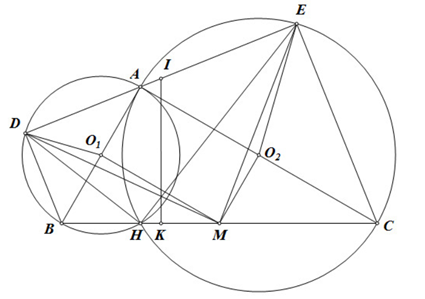
a) Gọi M là trung điểm \(BC \Rightarrow M{O_1} = \frac{1}{2}AC;M{O_2} = \frac{1}{2}AB.\)
Do D thuộc đường tròn đường kính AB nên tam giác ADB vuông tại D.
\( \Rightarrow D{O_1} = \frac{1}{2}AB = M{O_2}.\)Tương tự thì \(E{O_2} = M{O_1}\)
Có tam giác ABC vuông tại A (giả thiết). \(\widehat {ADB} + \widehat {EAC} = {90^o}\)
Mà tam giác DAB vuông tại D nên \(\widehat {ADB} + \widehat {DBA} = {90^o}\) \(\widehat {EAC} = \widehat {ABD} \Rightarrow 2\widehat {EAC} = 2\widehat {ABD} \Rightarrow \widehat {D{O_1}A} = \widehat {E{O_2}C} \Rightarrow \widehat {D{O_1}B} = \widehat {E{O_2}A}\)
Dễ thấy \(M{O_1}//AC,M{O_2}//AB \Rightarrow \widehat {M{O_1}B} = \widehat {M{O_2}A} = {90^o} \Rightarrow \widehat {M{O_1}D} = \widehat {M{O_2}E}\)
Xét \(\Delta M{O_1}D\) và \(\Delta E{O_2}M\) có:
\(M{O_1} = E{O_2}\) (cmt)
\(\widehat {D{O_1}M} = \widehat {M{O_2}E}\) (cmt)
\(D{O_1} = M{O_2}\) (cmt)
\( \Rightarrow \Delta M{O_1}D = \)\(\Delta E{O_2}M\) (c.g.c)
\( \Rightarrow MD = ME\) (2 cạnh tương ứng).
\( \Rightarrow M\) thuộc trung trực DE. Do đó trung trực DE luôn đi qua M cố định (đpcm).
b) Có \(2{S_{BDEC}} = 2{S_{BDA}} + 2{S_{BAC}} + 2{S_{AEC}} = DB.DA + AB.AC + EA.EC \le \frac{1}{2}\left( {B{D^2} + D{A^2}} \right) + \frac{1}{2}\left( {E{A^2} + E{C^2}} \right) + bc\) \(\begin{array}{l} = \frac{1}{2}\left( {A{B^2} + A{C^2}} \right) + bc = \frac{1}{2}\left( {{b^2} + {c^2}} \right) + bc = \frac{1}{2}{\left( {b + c} \right)^2}\\ \Rightarrow {S_{BDEC}} \le \frac{1}{4}{\left( {b + c} \right)^2} \Rightarrow Max = \frac{1}{4}{\left( {b + c} \right)^2}\end{array}\)
Dấu "=" xảy ra \( \Leftrightarrow DA = DB,EA = EC. \Leftrightarrow \) d tạo với AB một góc 45°.
c) Ta có điều phải chứng minh: \(K{B^2} = B{D^2} + K{H^2} \Leftrightarrow I{B^2} - K{I^2} = I{B^2} - I{D^2} + I{H^2} - I{K^2} \Leftrightarrow I{H^2} = I{D^2} \Rightarrow IH = ID = IE\)
Do đó tam giác DHE vuông tại H.
Thật vậy, có \(\widehat {DHB} + \widehat {EHC} = \widehat {DAB} + \widehat {EAC} = {90^o} \Rightarrow \widehat {DHE} = {90^o}\)
Đăng nhập để xem lời giải
Lưu tiến độ và luyện tập hiệu quả hơn. Trải nghiệm miễn phí!
Lời giải
a) Điều kiện: \(x \ge \frac{6}{5}\)
Từ giả thiết ta có: \( - {x^2} + 5x - 6 = 4x\left( {\sqrt {5x - 6} - x} \right)\) \( \Leftrightarrow - {x^2} + 5x - 6 = 4x.\frac{{ - {x^2} + 5x - 6}}{{\sqrt {5x - 6} + x}}\)
Vì \(x \ge \frac{6}{5}\) nên phương trình tương đương: \( \Leftrightarrow \left( {x - 2} \right)\left( {x - 3} \right)\left( {1 - \frac{{ - {x^2} + 5x - 6}}{{x + \sqrt {5x - 6} }}} \right) = 0\)
Do đó x = 2 hoặc x = 3 (thoả mãn điều kiện) hoặc: \(3x = \sqrt {5x - 6\;} \) (*)
Giải phương trình (*): \(9{x^2} = 5x - 6 \Leftrightarrow x\left( {x - \frac{5}{9}} \right) + \frac{2}{3} = 0\) ( vô nghiệm vì x ≥ \(\frac{6}{5}\) > \(\frac{5}{9}\))
Vậy phương trình có nghiệm x = 2 và x = 3
b) \(\left\{ {\begin{array}{*{20}{c}}{{x^3} - x{y^2} - 6y = 0{\kern 1pt} {\kern 1pt} {\kern 1pt} {\kern 1pt} {\kern 1pt} {\kern 1pt} {\kern 1pt} {\kern 1pt} {\kern 1pt} {\kern 1pt} {\kern 1pt} {\kern 1pt} {\kern 1pt} {\kern 1pt} {\kern 1pt} {\kern 1pt} {\kern 1pt} {\kern 1pt} {\kern 1pt} {\kern 1pt} {\kern 1pt} {\kern 1pt} {\kern 1pt} {\kern 1pt} {\kern 1pt} {\kern 1pt} {\kern 1pt} {\kern 1pt} {\kern 1pt} {\kern 1pt} {\kern 1pt} {\kern 1pt} {\kern 1pt} {\kern 1pt} {\kern 1pt} {\kern 1pt} {\kern 1pt} {\kern 1pt} {\kern 1pt} {\kern 1pt} {\kern 1pt} {\kern 1pt} {\kern 1pt} {\kern 1pt} {\kern 1pt} {\kern 1pt} {\kern 1pt} {\kern 1pt} {\kern 1pt} {\kern 1pt} {\kern 1pt} {\kern 1pt} {\kern 1pt} {\kern 1pt} {\kern 1pt} {\kern 1pt} {\kern 1pt} {\kern 1pt} {\kern 1pt} {\kern 1pt} {\kern 1pt} {\kern 1pt} {\kern 1pt} {\kern 1pt} {\kern 1pt} {\kern 1pt} {\kern 1pt} {\kern 1pt} {\kern 1pt} {\kern 1pt} \left( 1 \right)}\\{\left( {x + y} \right)\left( {x + 2y} \right) = 3\left( {xy + 2} \right){\kern 1pt} {\kern 1pt} {\kern 1pt} {\kern 1pt} {\kern 1pt} {\kern 1pt} {\kern 1pt} {\kern 1pt} {\kern 1pt} {\kern 1pt} {\kern 1pt} {\kern 1pt} {\kern 1pt} {\kern 1pt} {\kern 1pt} \left( 2 \right)}\end{array}} \right.\)
Xét (2): \(\left( {x + y} \right)\left( {x + 2y} \right) = 3\left( {xy + 2} \right) \Leftrightarrow {x^2} + 2{y^2} = 6\)
Từ (1): \({x^3} - x{y^2} - y\left( {{x^2} + 2{y^2}} \right) = 0 \Leftrightarrow {x^3} - x{y^2} - {\rm{y}}{{\rm{x}}^2} - 2{y^3} = 0\)
\( \Leftrightarrow \left( {x - 2y} \right)\left( {{x^2} + xy + {y^2}} \right) = 0\)
Ta để ý (x, y) = (0,0) không là nghiệm của hệ
do đó \({x^2} + xy + {y^2} = {\left( {x + \frac{y}{2}} \right)^2} + \frac{3}{4}{y^2} > 0\).
Vậy \(x = 2y \Rightarrow 6{y^2} = 6 \Rightarrow y = \pm 1\)
Nếu \(y = 1 \Rightarrow x = 2\) (Thử lại thoả mãn )
Nếu \(y = - 1 \Rightarrow x = - 2\)(Thử lại thoả mãn)
Vậy (x,y) = (2,1) và (x,y) = (−2,−1) là nghiệm của hệ.
Đăng nhập để xem lời giải
Lưu tiến độ và luyện tập hiệu quả hơn. Trải nghiệm miễn phí!
Lời giải
Bạn cần đăng ký gói VIP ( giá chỉ từ 199K ) để làm bài, xem đáp án và lời giải chi tiết không giới hạn.
Đăng nhập để xem lời giải
Lưu tiến độ và luyện tập hiệu quả hơn. Trải nghiệm miễn phí!
Lời giải
Bạn cần đăng ký gói VIP ( giá chỉ từ 199K ) để làm bài, xem đáp án và lời giải chi tiết không giới hạn.
Đăng ký để học cùng Vietjack. Trải nghiệm miễn phí!
Bằng việc đăng ký, bạn đồng ý với Điều khoản sử dụng và Chính sách bảo mật của Vietjack.
 Nhắn tin Zalo
 Hỏi bài tập