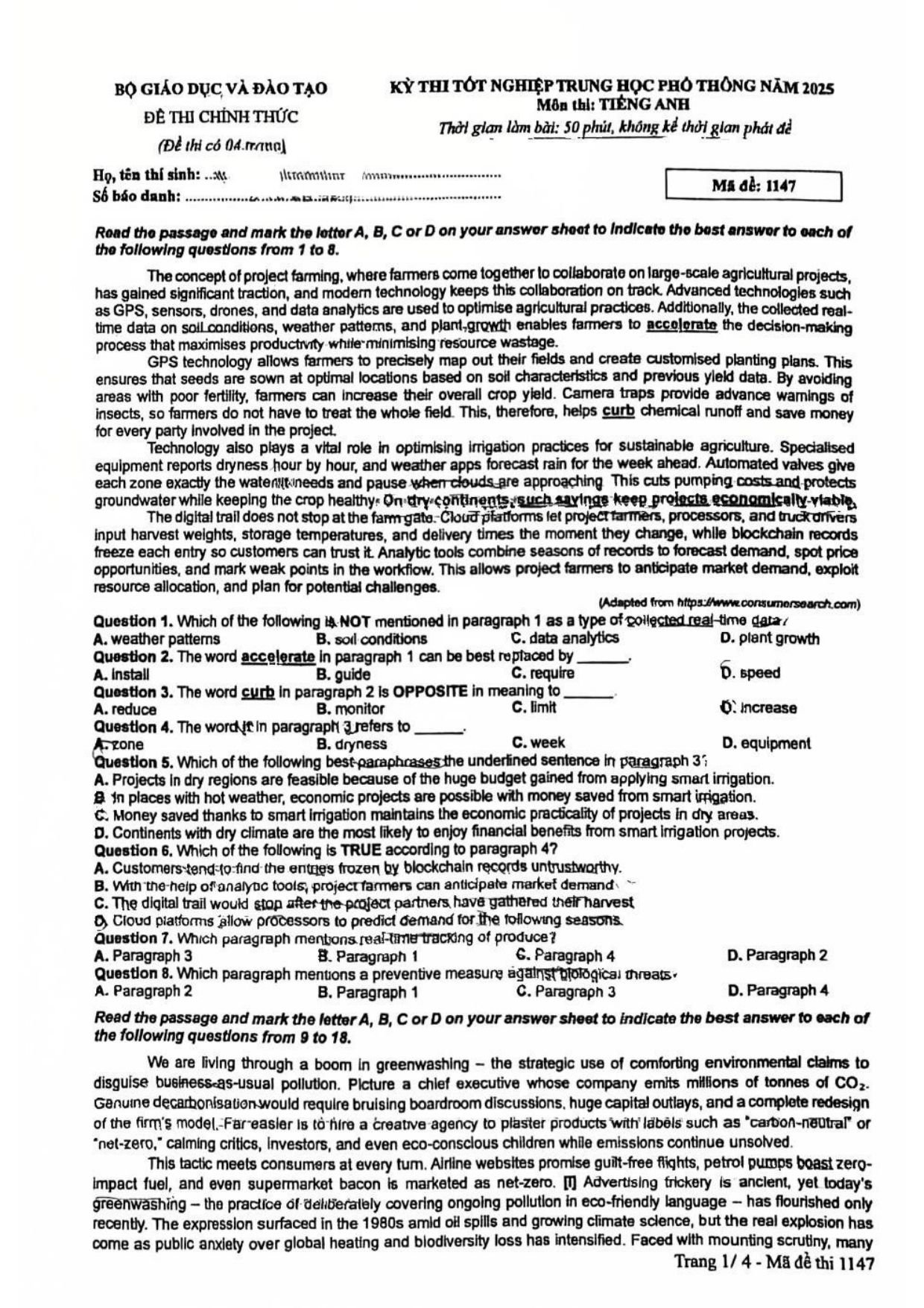
Read the following passage and mark the letter A, B, C or D on your answer sheet to indicate the best answer to each of the following questions from 1 to 8.
Many extinct species – from passenger pigeons to woolly mammoths – may now be reclassified as “bodily, but not genetically, extinct”, since their DNA can still be recovered from fossil specimens up to 200,000 years old. Developments in genetic technology may one day help bring such animals back to life. Only species whose DNA is too old to recover, such as dinosaurs, should be regarded as truly extinct.

The attempt to bring vanished creatures back to life will be expensive, technically difficult, and time-consuming, with no guarantee of success, so what makes it worthwhile? That something as final as extinction might be reversed, so that mammoths and passenger pigeons could be seen alive again, evokes the awe and wonder that drive all conservation at its deepest level.
Furthermore, the same logic underlying initiatives to protect endangered species applies to de-extinction plans: to restore and preserve biodiversity, advance scientific knowledge, and undo previous destruction. In this sense, resurrected species could become beacons of hope. While close examination of extinct species’ genomes can speak volumes about what made them vulnerable in the first place, living specimens would reveal even more. De-extinction techniques would also be directly applicable to critically endangered species, helping restore their genetic diversity. Lastly, as some extinct species once played vital roles in their ecosystems, bringing them back could also revive ecological richness and inspire wider conservation.
If de-extinction succeeds, today’s young people will have a chance to experience the return of some remarkable creatures in their lifetime – an experience that may define their generation’s attitude to the natural world and conservation. Given the number of species that have died out over the last 10,000 years due to manmade destruction, some resurrection and a measure of redemption are in order.
(Adapted from www.nationalgeographic.com)
Question 1. The phrase “such animals” in paragraph 1 refers to ______.
A. bodily, but not genetically, extinct species
B. all extinct species
C. genetically, but not bodily, extinct species
D. truly extinct species
Question 2. Which of the following is NOT mentioned in paragraph 2 as a difficulty facing de-extinction efforts?
A. the high costs
B. the emotional commitment
C. the uncertainty of success
D. the lengthy research process
Question 3. Which of the following best paraphrases the underlined sentence in paragraph 2?
A. The prospect of reviving extinct species is motivated by conservationists’ feelings of amazement and admiration.
B. The idea that extinct species could be revived and observed again comes from awe-inspiring conservation.
C. The thought of undoing extinction stirs up a profound emotional response that lies at the heart of conservation.
D. The likelihood of bringing vanished species back to life is a powerfully emotional one for many conservationists.
Question 4. The phrase “speak volumes” in paragraph 3 is OPPOSITE in meaning to ______.
A. conceal
B. indicate
C. demonstrate
D. show
Question 5. Which of the following is TRUE according to paragraph 3?
A. The usefulness of de-extinction technology remains limited to critically endangered species.
B. Revived extinct specimens could provide fewer genetic insights than could their fossil specimens.
C. The aims of wildlife conservationists and of those seeking to revive extinct species are similar.
D. Reviving ecologically important extinct species would have little impact on regional conservation.























 Nhắn tin Zalo
 Hỏi bài tập