






















Trong không gian, cho hình chóp S.ABCD có đáy ABCD là hình bình hành tâm O. Gọi G là điểm thỏa mãn \(\overrightarrow {GS} + \overrightarrow {GA} + \overrightarrow {GB} + \overrightarrow {GC} + \overrightarrow {GD} = \overrightarrow 0 \)(tham khảo hình vẽ)
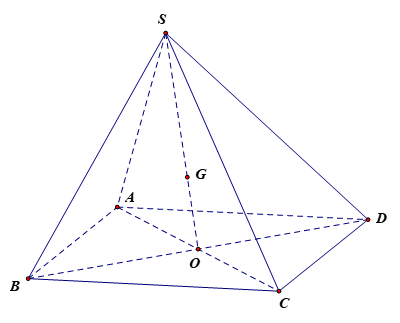
(a) Hai vectơ \(\overrightarrow {AO} ;\overrightarrow {CO} \) bằng nhau.
(b)\(\overrightarrow {SB} + \overrightarrow {SD} = \overrightarrow {SA} + \overrightarrow {SC} \).
(c)\(\overrightarrow {GS} = 4\overrightarrow {OG} \).
(d) Nếu tam giác ABC có AB = 2a; \(BC = a\sqrt 7 \); AC = 3a thì \(\overrightarrow {AB} .\overrightarrow {AC} = 3{a^2}\).
Câu hỏi trong đề: Trắc nghiệm Vectơ trong không gian lớp 12 (có đáp án) !!
Quảng cáo
Trả lời:
 Giải bởi Vietjack
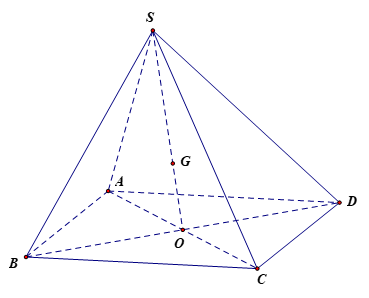
a) Hai vectơ \(\overrightarrow {AO} ;\overrightarrow {CO} \) cùng độ dài nhưng ngược hướng nên hai vectơ này không bằng nhau.
b) Ta có \(\overrightarrow {SB} + \overrightarrow {SD} = \overrightarrow {SA} + \overrightarrow {SC} = 2\overrightarrow {SO} \).
c) \(\overrightarrow {GS} + \overrightarrow {GA} + \overrightarrow {GB} + \overrightarrow {GC} + \overrightarrow {GD} = \overrightarrow 0 \)\( \Leftrightarrow \overrightarrow {GS} + \overrightarrow {OA} + \overrightarrow {OB} + \overrightarrow {OC} + \overrightarrow {OD} - 4\overrightarrow {OG} = \overrightarrow 0 \)
\( \Leftrightarrow \overrightarrow {GS} - 4\overrightarrow {OG} = \overrightarrow 0 \) (vì \(\overrightarrow {OA} + \overrightarrow {OB} + \overrightarrow {OC} + \overrightarrow {OD} = \overrightarrow 0 \))
\( \Leftrightarrow \overrightarrow {GS} = 4\overrightarrow {OG} \).
d) Xét ABC có \(\cos \widehat {BAC} = \frac{{A{B^2} + A{C^2} - B{C^2}}}{{2.AB.AC}} = \frac{{4{a^2} + 9{a^2} - 7{a^2}}}{{2.2a.3a}} = \frac{{6{a^2}}}{{12{a^2}}} = \frac{1}{2}\).
Ta có \(\overrightarrow {AB} .\overrightarrow {AC} = \left| {\overrightarrow {AB} } \right|.\left| {\overrightarrow {AC} } \right|.\cos \left( {\overrightarrow {AB} ,\overrightarrow {AC} } \right) = \left| {\overrightarrow {AB} } \right|.\left| {\overrightarrow {AC} } \right|.\cos \widehat {BAC}\)\( = 2a.3a.\frac{1}{2} = 3{a^2}\).
Đáp án: a) Sai; b) Đúng; c) Đúng; d) Đúng.
Hot: Giáo án năng lực số, PPT AI khởi động lớp 1-12 (Update 2026) (chỉ từ 150k). Tải ngay
CÂU HỎI HOT CÙNG CHỦ ĐỀ
Lời giải
Đáp án:
Gọi I là tâm hình vuông ABCD. gọi G là trọng tâm của tam giác AB'C.
(a) \(\overrightarrow {AB} + \overrightarrow {AD} + \overrightarrow {AA'} = \overrightarrow {AC'} \).
(b) \(\overrightarrow {GA} + \overrightarrow {GB'} + \overrightarrow {GC} = 2\overrightarrow {GI} \).
(c) \(\overrightarrow {AB} + \overrightarrow {AD} = \overrightarrow {A'C'} \).
(d)\(\overrightarrow {BD'} = 2\overrightarrow {BG} \).
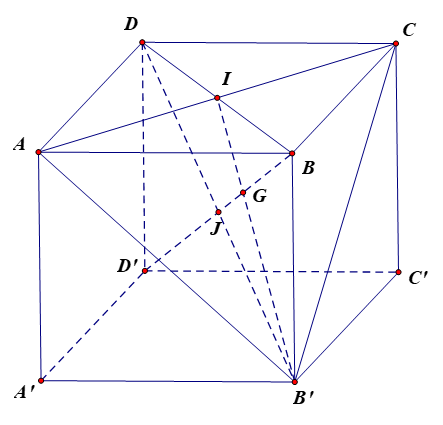
a) Theo quy tắc hình hộp ta có \(\overrightarrow {AB} + \overrightarrow {AD} + \overrightarrow {AA'} = \overrightarrow {AC'} \).
b) Vì G là trọng tâm AB'C nên \(\overrightarrow {GA} + \overrightarrow {GB'} + \overrightarrow {GC} = \overrightarrow 0 \).
c) Theo quy tắc hình bình hành \(\overrightarrow {AB} + \overrightarrow {AD} = \overrightarrow {AC} \) mà \(\overrightarrow {AC} = \overrightarrow {A'C'} \) nên \(\overrightarrow {AB} + \overrightarrow {AD} = \overrightarrow {A'C'} \).
d) Xét BDB' có I là trung điểm của BD và \(B'G = \frac{2}{3}B'I\) nên G là trọng tâm BDB'.
Gọi J là tâm của hình bình hành BDD'B'.
Khi đó \(\overrightarrow {BG} = \frac{2}{3}\overrightarrow {BJ} = \frac{2}{3}.\frac{1}{2}\overrightarrow {BD'} \)\( \Rightarrow \overrightarrow {BD'} = 3\overrightarrow {BG} \).
Đáp án: a) Đúng; b) Sai; c) Đúng; d) Sai.
Câu 2
\(2\overrightarrow {SO} \).
\(4\overrightarrow {SO} \).
\(3\overrightarrow {SO} \).
\(\overrightarrow 0 \).
Lời giải
Đáp án đúng: B
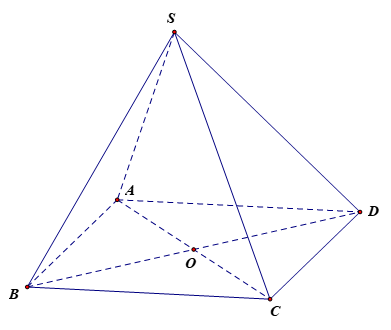
Vì ABCD là hình bình hành nên O là trung điểm của AC, BD.
Khi đó \(\overrightarrow {SA} + \overrightarrow {SC} = 2\overrightarrow {SO} \); \(\overrightarrow {SB} + \overrightarrow {SD} = 2\overrightarrow {SO} \).
Do đó \(\overrightarrow {SA} + \overrightarrow {SB} + \overrightarrow {SC} + \overrightarrow {SD} = 4\overrightarrow {SO} \).
Lời giải
Bạn cần đăng ký gói VIP ( giá chỉ từ 250K ) để làm bài, xem đáp án và lời giải chi tiết không giới hạn.
Lời giải
Bạn cần đăng ký gói VIP ( giá chỉ từ 250K ) để làm bài, xem đáp án và lời giải chi tiết không giới hạn.
Lời giải
Bạn cần đăng ký gói VIP ( giá chỉ từ 250K ) để làm bài, xem đáp án và lời giải chi tiết không giới hạn.
Lời giải
Bạn cần đăng ký gói VIP ( giá chỉ từ 250K ) để làm bài, xem đáp án và lời giải chi tiết không giới hạn.
 Nhắn tin Zalo
 Hỏi bài tập