






















As kids, our grandparents frequently scared us by talking about how difficult life was when they were growing up. They mentioned walking miles to school in the snow, or doing hours of manual labour for little pay. Life has changed greatly since then, and it seems to get easier year by year. In fact, with the help of robots we soon might have to do much at all. But is this a good thing?
By 2030, it’s estimated that robotics will be a $10 billion business worldwide. Companies are already starting to integrate them into the workforce. The electronics manufacturer Foxconn is drawing up plans to launch a factory within the next 10 years that’s completely staffed by robot workers. Meanwhile, an American company Briggo has invented a robot that serves gourmet- quality coffee to customers. With the push of a button it will crush coffee beans, measure exact quantities of water, and even wave a steam wand to ensure customers get the perfect cream on top. Unlike human baristas, it can serve multiple drinks at once and work all day and night without a break.
Robots are also invading our homes. The Rooma is a mini-robot that vacuums rooms automatically according to a schedule. The Robomow is a device that will cut the grass for you while you sit in the shade. Then there’s the Nanda clocky, an alarm clock that makes sure that even the deepest sleepers get up on time. The clock is attached to a pair of wheels, and it will randomly move around the room. Once you finally catch it, you’re probably too awake to hit the snooze button. Although these early home robots are somewhat basic, they will likely become more capable as times goes on.
Although robots certainly help us to eliminate tedious tasks, many people are concerned about a future filled with robots. Some fear that humanity will start to decline if machines do everything for us. Others have even warned about the robot rebellion, in which robots become so smart that they may decide to turn on their masters. These ideas may seem a bit far-fetched, but there are certainly lots of questions that need to be answered before everyone opens up to the idea of a robotic future.
As kids, our grandparents frequently scared us by talking about how difficult life was when they were growing up. They mentioned walking miles to school in the snow, or doing hours of manual labour for little pay. Life has changed greatly since then, and it seems to get easier year by year. In fact, with the help of robots we soon might have to do much at all. But is this a good thing?
By 2030, it’s estimated that robotics will be a $10 billion business worldwide. Companies are already starting to integrate them into the workforce. The electronics manufacturer Foxconn is drawing up plans to launch a factory within the next 10 years that’s completely staffed by robot workers. Meanwhile, an American company Briggo has invented a robot that serves gourmet- quality coffee to customers. With the push of a button it will crush coffee beans, measure exact quantities of water, and even wave a steam wand to ensure customers get the perfect cream on top. Unlike human baristas, it can serve multiple drinks at once and work all day and night without a break.
Robots are also invading our homes. The Rooma is a mini-robot that vacuums rooms automatically according to a schedule. The Robomow is a device that will cut the grass for you while you sit in the shade. Then there’s the Nanda clocky, an alarm clock that makes sure that even the deepest sleepers get up on time. The clock is attached to a pair of wheels, and it will randomly move around the room. Once you finally catch it, you’re probably too awake to hit the snooze button. Although these early home robots are somewhat basic, they will likely become more capable as times goes on.
Although robots certainly help us to eliminate tedious tasks, many people are concerned about a future filled with robots. Some fear that humanity will start to decline if machines do everything for us. Others have even warned about the robot rebellion, in which robots become so smart that they may decide to turn on their masters. These ideas may seem a bit far-fetched, but there are certainly lots of questions that need to be answered before everyone opens up to the idea of a robotic future.
What does “them” in paragraph 2 refer to?
Quảng cáo
Trả lời:
 Giải bởi Vietjack
Đáp án đúng là A
Phương pháp giải
Thông tin: By 2030, it’s estimated that robotics will be a $10 billion business worldwide. Companies are already starting to integrate them into the workforce.
Lời giải
“Them” trong đoạn 2 ám chỉ điều gì?
A. robotics
B. companies
C. electronics
D. business
Thông tin: By 2030, it’s estimated that robotics will be a $10 billion business worldwide. Companies are already starting to integrate them into the workforce.
Tạm dịch: Đến năm 2030, người ta ước tính rằng robot sẽ là một ngành kinh doanh trị giá 10 tỷ đô la trên toàn thế giới. Các công ty đã bắt đầu tích hợp chúng vào lực lượng lao động.
Câu hỏi cùng đoạn
Câu 2:
How is Briggo’s invention superior to human workers?
How is Briggo’s invention superior to human workers?
Giải bởi Vietjack
Đáp án đúng là C
Phương pháp giải
Đọc hiểu tìm thông tin đoạn 2
Lời giải
Phát minh của Briggo vượt trội hơn con người như thế nào?
A. Nó hiểu biết hơn về cách pha cà phê.
B. Nó giỏi hơn trong việc trò chuyện.
C. Nó không bao giờ phải dừng lại.
D. Nó có thể vận hành máy móc.
Thông tin: Unlike human baristas, it can serve multiple drinks at once and work all day and night without a break.
Tạm dịch: Không giống như nhân viên pha chế, nó có thể phục vụ nhiều đồ uống cùng một lúc và hoạt động cả ngày lẫn đêm không nghỉ.
Câu 3:
What can robots NOT do?
What can robots NOT do?
Giải bởi Vietjack
Đáp án đúng là C
Phương pháp giải
Đọc hiểu tìm thông tin đoạn 2, 3
Lời giải
Robot KHÔNG THỂ làm gì?
A. Làm việc liên tục trong nhiều giờ
B. Hoàn thành việc nhà theo lịch trình
C. Lên kế hoạch ra mắt một câu chuyện
D. Làm những công việc nhàm chán cho con người
Thông tin:
- Unlike human baristas, it can serve multiple drinks at once and work all day and night without a break.
- Robots are also invading our homes. The Rooma is a mini-robot that vacuums rooms automatically according to a schedule.
- Although robots certainly help us to eliminate tedious tasks, many people are concerned about a future filled with robots.
Tạm dịch:
- Không giống như nhân viên pha chế, nó có thể phục vụ nhiều đồ uống cùng một lúc và làm việc cả ngày lẫn đêm mà không nghỉ.
- Robot cũng đang xâm chiếm nhà của chúng ta. Rooma là một robot mini tự động hút bụi phòng theo lịch trình.
- Mặc dù robot chắc chắn giúp chúng ta loại bỏ các công việc tẻ nhạt, nhưng nhiều người lo ngại về tương lai sẽ tràn ngập robot.
Câu 4:
What is the last paragraph mainly about?
Giải bởi Vietjack
Đáp án đúng là A
Phương pháp giải
Đọc hiểu đoạn cuối
Lời giải
Đoạn văn cuối chủ yếu nói về điều gì?
A. Một số lý do tại sao mọi người vẫn chưa chấp nhận robot.
B. Một câu chuyện khoa học viễn tưởng rất thú vị về robot.
C. Người dân trong cộng đồng địa phương đang ủng hộ robot như thế nào.
D. Một số robot mới nhất trên thị trường hiện nay.
Thông tin: Although robots certainly help us to eliminate tedious tasks, many people are concerned about a future filled with robots.
Tạm dịch: Mặc dù các robot chắc chắn giúp chúng ta loại bỏ các việc tẻ nhạt, nhiều người lo ngại về tương lai đầy robot.
Câu 5:
What can be inferred from the passage?
What can be inferred from the passage?
Giải bởi Vietjack
Đáp án đúng là D
Phương pháp giải
Đọc hiểu toàn bài
Lời giải
Có thể suy ra điều gì từ đoạn văn?
A. Robot gia dụng hiện tại có thể hoạt động mà không cần bất kỳ chương trình nào.
B. Giao tiếp sẽ suy giảm khi sử dụng robot.
C. Một cuộc nổi loạn của robot có thể xảy ra hàng ngày.
D. Robot sẽ trở thành một ngành kinh doanh lớn vào năm 2030.
Thông tin: By 2030, it’s estimated that robotics will be a $10 billion business worldwide. Companies are already starting to integrate them into the workforce.
Tạm dịch: Đến năm 2030, người ta ước tính rằng robot sẽ là một kinh doanh trị giá 10 tỷ USD trên toàn thế giới. Các công ty đã bắt đầu tích hợp chúng vào lực lượng lao động.
Đăng nhập để xem lời giải
Lưu tiến độ và luyện tập hiệu quả hơn. Hoàn toàn miễn phí!
Đang tải chế độ Học...
Hot: 1000+ đề thi giữa kì 1 lớp 1-12 đầy đủ các môn (Update 2026) (chỉ từ 60k). Tải ngay
Đăng ký VIP để học và luyện thi không giới hạn
Trọn bộ quyền lợi trên Vietjack, trong một tài khoản.
- Phòng luyện thi cấp tốc: ĐGNL - ĐGTD, Tốt nghiệp THPT, Ôn vào 10, Ôn vào 6, Ôn Giữa kì/Cuối kì
- Hơn 200K đề thi thử, đề minh hoạ, chính thức các năm
- Với 3tr+ câu hỏi theo các mức độ Nhận biết, Thông hiểu, Vận dụng
- Tải xuống đề thi [DOCX] với đầy đủ đáp án
- Xem hàng ngàn bài giảng đính kèm củng cố thêm kiến thức
- Bao gồm tất cả các bậc từ Tiểu học đến Đại học
- Chặn hiển thị quảng cáo tăng khả năng tập trung ôn luyện
- Đăng ký ngay
CÂU HỎI HOT CÙNG CHỦ ĐỀ
Câu 1
Đăng nhập để xem lời giải
Lưu tiến độ và luyện tập hiệu quả hơn. Hoàn toàn miễn phí!
Lời giải
Đáp án đúng là B
Phương pháp giải
Vận dụng các công thức xác suất (công thức cộng, công thức nhân, công thức xác suất toàn phần, công thức Bayes...)
Lời giải
Gọi \(A\) là biến cố "Bị mắc bệnh M", \(B\) là biến cố "Bộ test cho kết quả dương tính".
Do xác suất bị mắc bệnh M là \(22{\rm{\% }}\) nên \(P\left( A \right) = 0,22\).
Từ dữ kiện "Nếu một người không bị bệnh thì xác suất bộ test cho ra kết quả dương tính là \(10{\rm{\% }}\)" suy ra \(P\left( {B\mid \overline A } \right) = 0,1\).
Từ dữ kiện "Nếu bộ test cho ra kết quả dương tính thì xác suất bị bệnh là \(70{\rm{\% }}\)"suy ra \(P\left( {A\mid B} \right) = 0,7\).
Từ ba dữ kiện trên, ta có hệ phương trình:
\(\left\{ {\begin{array}{*{20}{l}}{P\left( A \right) = 0,22}\\{P\left( {B\mid \overline A } \right) = 0,1}\\{P\left( {A\mid B} \right) = 0,7}\end{array} \Leftrightarrow \left\{ {\begin{array}{*{20}{l}}{P\left( A \right) = 0,22}\\{\frac{{P\left( {\overline A B} \right)}}{{P\left( {\overline A } \right)}} = 0,1}\\{\frac{{P\left( {AB} \right)}}{{P\left( B \right)}} = 0,7}\end{array}} \right.} \right.\)
\( \Leftrightarrow \left\{ {\begin{array}{*{20}{l}}{P\left( A \right) = 0,22}\\{P\left( {\overline A B} \right) = 0,1.P\left( {\overline A } \right) = 0,1.0,78 = 0,078}\\{\frac{{P\left( B \right) - P\left( {\overline A B} \right)}}{{P\left( B \right)}} = 0,7}\end{array}} \right.\)
\( \Leftrightarrow \left\{ {\begin{array}{*{20}{l}}{P\left( A \right) = 0,22}\\{P\left( {\overline A B} \right) = 0,078}\\{1 - \frac{{0,078}}{{P\left( B \right)}} = 0,7}\end{array} \Leftrightarrow \left\{ {\begin{array}{*{20}{l}}{P\left( A \right) = 0,22}\\{P\left( {\overline A B} \right) = 0,078}\\{P\left( B \right) = 0,26}\end{array}} \right.} \right.\)
Xác suất cần tính chính là
\(P\left( {B\mid A} \right) = \frac{{P\left( {AB} \right)}}{{P\left( A \right)}} = \frac{{P\left( B \right) - P\left( {\overline A B} \right)}}{{P\left( A \right)}} = \frac{{0,26 - 0,078}}{{0,22}} = 0,8273 = 82,73{\rm{\% }}\)
Đăng nhập để xem lời giải
Lưu tiến độ và luyện tập hiệu quả hơn. Hoàn toàn miễn phí!
Lời giải
Đáp án đúng là B
Phương pháp giải
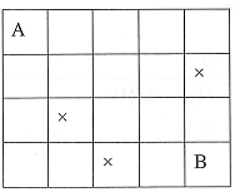
Tìm số cách đi đến từng ô vuông một.
Lời giải
Số cách đi tới một ô vuông sẽ bằng tổng số cách đi tới ô vuông ngay trên nó và số cách đi tới ô vuông bên trái nó.
Nếu ô vuông đó không thể đi vào, số cách đi vào ô vuông đó sẽ bằng 0.
Qua đó, ta có bảng số cách đi tới từng ô vuông như sau:
|
1 |
1 |
1 |
1 |
1 |
|
1 |
2 |
3 |
4 |
0 |
|
1 |
0 |
3 |
7 |
7 |
|
1 |
1 |
0 |
7 |
14 |
Như vậy, có 14 cách cho con kiến đi tới ô vuông B từ ô vuông A.
Câu 3
Đăng nhập để xem lời giải
Lưu tiến độ và luyện tập hiệu quả hơn. Hoàn toàn miễn phí!
Lời giải
Bạn cần đăng ký gói VIP ( giá chỉ từ 250K ) để làm bài, xem đáp án và lời giải chi tiết không giới hạn.
Đăng nhập để xem lời giải
Lưu tiến độ và luyện tập hiệu quả hơn. Hoàn toàn miễn phí!
Lời giải
Bạn cần đăng ký gói VIP ( giá chỉ từ 250K ) để làm bài, xem đáp án và lời giải chi tiết không giới hạn.
Câu 5
Đăng nhập để xem lời giải
Lưu tiến độ và luyện tập hiệu quả hơn. Hoàn toàn miễn phí!
Lời giải
Bạn cần đăng ký gói VIP ( giá chỉ từ 250K ) để làm bài, xem đáp án và lời giải chi tiết không giới hạn.
Câu 6
Đăng nhập để xem lời giải
Lưu tiến độ và luyện tập hiệu quả hơn. Hoàn toàn miễn phí!
Lời giải
Bạn cần đăng ký gói VIP ( giá chỉ từ 250K ) để làm bài, xem đáp án và lời giải chi tiết không giới hạn.
Câu 7
Đăng nhập để xem lời giải
Lưu tiến độ và luyện tập hiệu quả hơn. Hoàn toàn miễn phí!
Lời giải
Bạn cần đăng ký gói VIP ( giá chỉ từ 250K ) để làm bài, xem đáp án và lời giải chi tiết không giới hạn.
Đăng ký để học cùng Vietjack. Hoàn toàn miễn phí!
Bằng việc đăng ký, bạn đồng ý với Điều khoản sử dụng và Chính sách bảo mật của Vietjack.
 Nhắn tin Zalo
 Hỏi bài tập