






















Another critical factor that plays a part in susceptibility to colds is age. A study done by the University of Michigan School of Public Health revealed particulars that seem to hold true for the general population. Infants are the most cold-ridden group, averaging more than six colds in their first year. Boys have more colds than girls up to age three. After the age of three, girls are more susceptible than boy's , and teenage girls average three colds a year to boy’s two.
The general incidence of continues to decline into maturity. Elderly people who are in good health have as few as one or two colds annually. One exception is founds among people in the twenties, especially women, who show a rise in cold infections, because people in this age group are most likely to have young children. Adults who delay having children until thirties forties experience the same sudden increase in cold infections.
The study also found that economics play an important role. As income increases, the frequency at which are reported in the family decreases. Families with the lowest income suffer about a third more colds than families at the lower end. Lower income generally forces people to live in more cramped quarters than those typically occupied by wealthier by wealthier people, and crowding increases the opportunities for the cold virus to travel from person to person. Low income may also adversely influence diet. The degree to which poor nutrition affects susceptibility to colds is not yet clearly established, but an inadequate diet is suspected of lowering resistance generally.
Additionally, lifestyle factors, such as stress and sleep patterns, play a significant role in susceptibility to colds. Chronic stress, for example, has been shown to weaken the immune system, making individuals more vulnerable to infections. People who experience high levels of stress or irregular sleep schedules may find themselves catching colds more frequently. Moreover, those who work in high-contact environments, such as schools or healthcare facilities, are also at greater risk, as they are more likely to be exposed to viruses. Regular physical activity, on the other hand, has been linked to a stronger immune response, which can reduce the frequency and severity of colds.
In conclusion, while age and economics are major factors in susceptibility, lifestyle choices and environmental exposures also play crucial roles in determining how often a person contracts a cold.
Another critical factor that plays a part in susceptibility to colds is age. A study done by the University of Michigan School of Public Health revealed particulars that seem to hold true for the general population. Infants are the most cold-ridden group, averaging more than six colds in their first year. Boys have more colds than girls up to age three. After the age of three, girls are more susceptible than boy's , and teenage girls average three colds a year to boy’s two.
The general incidence of continues to decline into maturity. Elderly people who are in good health have as few as one or two colds annually. One exception is founds among people in the twenties, especially women, who show a rise in cold infections, because people in this age group are most likely to have young children. Adults who delay having children until thirties forties experience the same sudden increase in cold infections.
The study also found that economics play an important role. As income increases, the frequency at which are reported in the family decreases. Families with the lowest income suffer about a third more colds than families at the lower end. Lower income generally forces people to live in more cramped quarters than those typically occupied by wealthier by wealthier people, and crowding increases the opportunities for the cold virus to travel from person to person. Low income may also adversely influence diet. The degree to which poor nutrition affects susceptibility to colds is not yet clearly established, but an inadequate diet is suspected of lowering resistance generally.
Additionally, lifestyle factors, such as stress and sleep patterns, play a significant role in susceptibility to colds. Chronic stress, for example, has been shown to weaken the immune system, making individuals more vulnerable to infections. People who experience high levels of stress or irregular sleep schedules may find themselves catching colds more frequently. Moreover, those who work in high-contact environments, such as schools or healthcare facilities, are also at greater risk, as they are more likely to be exposed to viruses. Regular physical activity, on the other hand, has been linked to a stronger immune response, which can reduce the frequency and severity of colds.
In conclusion, while age and economics are major factors in susceptibility, lifestyle choices and environmental exposures also play crucial roles in determining how often a person contracts a cold.
Which of the following is closet in meaning to the word “particulars” in paragraph 1?
Quảng cáo
Trả lời:
 Giải bởi Vietjack
Đáp án đúng là B
Phương pháp giải
Từ vựng (particulars: sự cụ thể, chi tiết)
Lời giải
Điều nào sau đây là gần nhất với ý nghĩa của từ " particulars " trong đoạn 1?
A. lỗi nhỏ
B. sự kiện cụ thể
C. sự phân biệt nhỏ
D. người cá nhân
=> "particulars" ~ specific facts: sự kiện cụ thể
Thông tin: Another critical factor that plays a part in susceptibility to colds is age. A study done by the University of Michigan School of Public Health revealed particulars that seem to hold true for the general population.
Tạm dịch: Một nhân tố khác quan trọng đóng góp một phần trong tính nhạy cảm với cảm lạnh là tuổi tác. Một nghiên cứu được thực hiện bởi Đại học Michigan Trường Y tế Công tiết lộ những dữ kiện cụ thể mà dường như đúng với dân số nói chung
Câu hỏi cùng đoạn
Câu 2:
What does the author claim about the study discussed in the passage?
What does the author claim about the study discussed in the passage?
Giải bởi Vietjack
Đáp án đúng là D
Phương pháp giải
Đọc hiểu tìm thông tin đoạn 1
Lời giải
Tác giả nhận định gì về nghiên cứu được thảo luận trong đoạn văn?
A. Nó chứa nhiều mâu thuẫn.
B. Nó chuyên về trẻ em.
C. Nó trái ngược với kết quả của các nghiên cứu trước đó trong lĩnh vực này.
D. Kết quả của nó dường như là phù hợp với dân số nói chung.
Thông tin: A study done by the University of Michigan School of Public Health revealed particulars that seem to hold true for the general population.
Tạm dịch: Một nghiên cứu được thực hiện bởi Đại học Michigan Trường Y tế Công tiết lộ những dữ kiện cụ thể mà dường như đúng với dân số nói chung.
Câu 3:
There is information in the second paragraph of the passage to support which of the following conclusions?
There is information in the second paragraph of the passage to support which of the following conclusions?
Giải bởi Vietjack
Đáp án đúng là D
Phương pháp giải
Đọc đoạn thông tin số 2.
Lời giải
Thông tin trong đoạn thứ 2 ủng hộ kết luận nào dưới đây?
A. Đàn ông dễ bị cảm lạnh hơn phụ nữ.
B. Người cao tuổi có khả năng bị cảm lạnh nhiều hơn.
C. Những người dưới bốn mươi tuổi có hệ thống miễn dịch mạnh hơn những người khác.
D. Những người dưới ba mươi tuổi có con dễ bị cảm lạnh hơn những người không có con.
Thông tin: One exception is found among people in their twenties, especially women, who show a rise in cold infections, because people in this age group are most likely to have young children. Adults who delay having children until thirties forties experience the same sudden increase in cold infections.
Tạm dịch: Một ngoại lệ được tìm thấy ở những người trong độ tuổi hai mươi, đặc biệt là phụ nữ, người thể hiện một sự gia tăng nhiễm lạnh, bởi vì những người trong độ tuổi này có nhiều khả năng có con nhỏ. Những người lớn trì hoãn việc sinh con cho đến độ tuổi ba mươi, bốn mươi cũng có nguy cơ mắc bệnh cảm lạnh đột ngột tăng cao.
Câu 4:
What does the phrase “people in this age group” refer to?
Giải bởi Vietjack
Đáp án đúng là B
Phương pháp giải
Thông tin: One exception is found among people in their twenties, especially women, who show a rise in cold infections, because people in this age group are most likely to have young children.
Lời giải
Cụm từ " in this age group" đề cập đến ai?
A. trẻ sơ sinh
B. người ở tuổi đôi mươi
C. người trong độ tuổi ba mươi hay bốn mươi
D. người già
Thông tin: One exception is found among people in their twenties, especially women, who show a rise in cold infections, because people in this age group are most likely to have young children.
Tạm dịch: Một ngoại lệ được tìm thấy ở những người trong độ tuổi hai mươi, đặc biệt là phụ nữ, người thể hiện một sự gia tăng nhiễm lạnh, bởi vì những người trong độ tuổi này có nhiều khả năng có con nhỏ.
Câu 5:
Which of the following best paraphrases this sentence: “Those who work in high-contact environments, such as schools or healthcare facilities, are also at greater risk, as they are more likely to be exposed to viruses.”?
Giải bởi Vietjack
Đáp án đúng là C
Phương pháp giải
Đọc hiểu và dịch nghĩa
Lời giải
Câu nào sau đây diễn giải đúng nhất câu này: “Những người làm việc trong môi trường tiếp xúc nhiều, chẳng hạn như trường học hoặc cơ sở chăm sóc sức khỏe, cũng có nguy cơ cao hơn vì họ có nhiều khả năng tiếp xúc với vi-rút hơn.”?
A. Những người làm công việc tiếp xúc nhiều, chẳng hạn như giảng dạy hoặc chăm sóc sức khỏe, ít có khả năng bị bệnh hơn do hệ thống miễn dịch mạnh. => sai vì nguyên nhân mắc bệnh là nguy cơ tiếp xúc vi-rút
B. Những người làm việc trong môi trường như trường học hoặc phòng khám được bảo vệ khỏi vi-rút do bản chất công việc của họ. => sai vì không nhắc đến sự bảo vệ
C. Những người làm việc ở những nơi như trường học hoặc bệnh viện có nguy cơ bị bệnh cao hơn do thường xuyên tiếp xúc với vi-rút. => sát nghĩa câu gốc
D. Những người làm việc trong môi trường chăm sóc sức khỏe và giáo dục tránh được bệnh tật vì vi-rút ít phổ biến hơn trong những môi trường đó. => sai vì trái nghĩa câu gốc
Đăng nhập để xem lời giải
Lưu tiến độ và luyện tập hiệu quả hơn. Hoàn toàn miễn phí!
Đang tải chế độ Học...
Hot: 1000+ đề thi giữa kì 1 lớp 1-12 đầy đủ các môn (Update 2026) (chỉ từ 60k). Tải ngay
Đăng ký VIP để học và luyện thi không giới hạn
Trọn bộ quyền lợi trên Vietjack, trong một tài khoản.
- Phòng luyện thi cấp tốc: ĐGNL - ĐGTD, Tốt nghiệp THPT, Ôn vào 10, Ôn vào 6, Ôn Giữa kì/Cuối kì
- Hơn 200K đề thi thử, đề minh hoạ, chính thức các năm
- Với 3tr+ câu hỏi theo các mức độ Nhận biết, Thông hiểu, Vận dụng
- Tải xuống đề thi [DOCX] với đầy đủ đáp án
- Xem hàng ngàn bài giảng đính kèm củng cố thêm kiến thức
- Bao gồm tất cả các bậc từ Tiểu học đến Đại học
- Chặn hiển thị quảng cáo tăng khả năng tập trung ôn luyện
- Đăng ký ngay
CÂU HỎI HOT CÙNG CHỦ ĐỀ
Câu 1
Đăng nhập để xem lời giải
Lưu tiến độ và luyện tập hiệu quả hơn. Hoàn toàn miễn phí!
Lời giải
Đáp án đúng là B
Phương pháp giải
Vận dụng các công thức xác suất (công thức cộng, công thức nhân, công thức xác suất toàn phần, công thức Bayes...)
Lời giải
Gọi \(A\) là biến cố "Bị mắc bệnh M", \(B\) là biến cố "Bộ test cho kết quả dương tính".
Do xác suất bị mắc bệnh M là \(22{\rm{\% }}\) nên \(P\left( A \right) = 0,22\).
Từ dữ kiện "Nếu một người không bị bệnh thì xác suất bộ test cho ra kết quả dương tính là \(10{\rm{\% }}\)" suy ra \(P\left( {B\mid \overline A } \right) = 0,1\).
Từ dữ kiện "Nếu bộ test cho ra kết quả dương tính thì xác suất bị bệnh là \(70{\rm{\% }}\)"suy ra \(P\left( {A\mid B} \right) = 0,7\).
Từ ba dữ kiện trên, ta có hệ phương trình:
\(\left\{ {\begin{array}{*{20}{l}}{P\left( A \right) = 0,22}\\{P\left( {B\mid \overline A } \right) = 0,1}\\{P\left( {A\mid B} \right) = 0,7}\end{array} \Leftrightarrow \left\{ {\begin{array}{*{20}{l}}{P\left( A \right) = 0,22}\\{\frac{{P\left( {\overline A B} \right)}}{{P\left( {\overline A } \right)}} = 0,1}\\{\frac{{P\left( {AB} \right)}}{{P\left( B \right)}} = 0,7}\end{array}} \right.} \right.\)
\( \Leftrightarrow \left\{ {\begin{array}{*{20}{l}}{P\left( A \right) = 0,22}\\{P\left( {\overline A B} \right) = 0,1.P\left( {\overline A } \right) = 0,1.0,78 = 0,078}\\{\frac{{P\left( B \right) - P\left( {\overline A B} \right)}}{{P\left( B \right)}} = 0,7}\end{array}} \right.\)
\( \Leftrightarrow \left\{ {\begin{array}{*{20}{l}}{P\left( A \right) = 0,22}\\{P\left( {\overline A B} \right) = 0,078}\\{1 - \frac{{0,078}}{{P\left( B \right)}} = 0,7}\end{array} \Leftrightarrow \left\{ {\begin{array}{*{20}{l}}{P\left( A \right) = 0,22}\\{P\left( {\overline A B} \right) = 0,078}\\{P\left( B \right) = 0,26}\end{array}} \right.} \right.\)
Xác suất cần tính chính là
\(P\left( {B\mid A} \right) = \frac{{P\left( {AB} \right)}}{{P\left( A \right)}} = \frac{{P\left( B \right) - P\left( {\overline A B} \right)}}{{P\left( A \right)}} = \frac{{0,26 - 0,078}}{{0,22}} = 0,8273 = 82,73{\rm{\% }}\)
Đăng nhập để xem lời giải
Lưu tiến độ và luyện tập hiệu quả hơn. Hoàn toàn miễn phí!
Lời giải
Đáp án đúng là B
Phương pháp giải
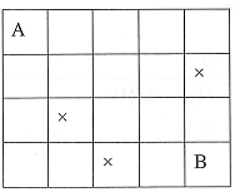
Tìm số cách đi đến từng ô vuông một.
Lời giải
Số cách đi tới một ô vuông sẽ bằng tổng số cách đi tới ô vuông ngay trên nó và số cách đi tới ô vuông bên trái nó.
Nếu ô vuông đó không thể đi vào, số cách đi vào ô vuông đó sẽ bằng 0.
Qua đó, ta có bảng số cách đi tới từng ô vuông như sau:
|
1 |
1 |
1 |
1 |
1 |
|
1 |
2 |
3 |
4 |
0 |
|
1 |
0 |
3 |
7 |
7 |
|
1 |
1 |
0 |
7 |
14 |
Như vậy, có 14 cách cho con kiến đi tới ô vuông B từ ô vuông A.
Câu 3
Đăng nhập để xem lời giải
Lưu tiến độ và luyện tập hiệu quả hơn. Hoàn toàn miễn phí!
Lời giải
Bạn cần đăng ký gói VIP ( giá chỉ từ 250K ) để làm bài, xem đáp án và lời giải chi tiết không giới hạn.
Đăng nhập để xem lời giải
Lưu tiến độ và luyện tập hiệu quả hơn. Hoàn toàn miễn phí!
Lời giải
Bạn cần đăng ký gói VIP ( giá chỉ từ 250K ) để làm bài, xem đáp án và lời giải chi tiết không giới hạn.
Câu 5
Đăng nhập để xem lời giải
Lưu tiến độ và luyện tập hiệu quả hơn. Hoàn toàn miễn phí!
Lời giải
Bạn cần đăng ký gói VIP ( giá chỉ từ 250K ) để làm bài, xem đáp án và lời giải chi tiết không giới hạn.
Câu 6
Đăng nhập để xem lời giải
Lưu tiến độ và luyện tập hiệu quả hơn. Hoàn toàn miễn phí!
Lời giải
Bạn cần đăng ký gói VIP ( giá chỉ từ 250K ) để làm bài, xem đáp án và lời giải chi tiết không giới hạn.
Câu 7
Đăng nhập để xem lời giải
Lưu tiến độ và luyện tập hiệu quả hơn. Hoàn toàn miễn phí!
Lời giải
Bạn cần đăng ký gói VIP ( giá chỉ từ 250K ) để làm bài, xem đáp án và lời giải chi tiết không giới hạn.
Đăng ký để học cùng Vietjack. Hoàn toàn miễn phí!
Bằng việc đăng ký, bạn đồng ý với Điều khoản sử dụng và Chính sách bảo mật của Vietjack.
 Nhắn tin Zalo
 Hỏi bài tập