






















Trong mặt phẳng tọa độ \[Oxy,\] cho parabol \(\left( P \right):y = 2{x^2}\) và đường thẳng \(\left( d \right):y = x + m\) (với \(m\) là tham số).
a) Tìm \(m\) để \(\left( d \right)\) đi qua điểm \(A\left( {2;8} \right)\).
b) Tìm \(m\) để \(\left( d \right)\) cắt \(\left( P \right)\)tại hai điểm phân biệt có hoành độ \({x_1},{x_2}\) thỏa mãn \({x_1} + {x_2} - 3{x_1}{x_2} = 5\).
Trong mặt phẳng tọa độ \[Oxy,\] cho parabol \(\left( P \right):y = 2{x^2}\) và đường thẳng \(\left( d \right):y = x + m\) (với \(m\) là tham số).
a) Tìm \(m\) để \(\left( d \right)\) đi qua điểm \(A\left( {2;8} \right)\).
b) Tìm \(m\) để \(\left( d \right)\) cắt \(\left( P \right)\)tại hai điểm phân biệt có hoành độ \({x_1},{x_2}\) thỏa mãn \({x_1} + {x_2} - 3{x_1}{x_2} = 5\).
Quảng cáo
Trả lời:
 Giải bởi Vietjack
a) Đường thẳng \(\left( d \right):y = x + m\) đi qua điểm \(A\left( {2;8} \right)\)\( \Leftrightarrow 2 + m = 8 \Leftrightarrow m = 6\).
Vậy \(m = 6\) thì \(\left( d \right)\) đi qua điểm \(A\left( {2;8} \right)\).
b) Xét phương trình hoành độ giao điểm của parabol \(\left( P \right):y = 2{x^2}\) và đường thẳng \(\left( d \right):y = x + m\) là: \(2{x^2} = x + m \Leftrightarrow 2{x^2} - x - m = 0{\rm{ }}\left( * \right)\).
Phương trình \(\left( * \right)\)có: \(\Delta = {\left( { - 1} \right)^2} - 4.2.\left( { - m} \right) = 1 + 8m\).
Để \(\left( d \right)\) cắt \(\left( P \right)\)tại hai điểm phân biệt có hoành độ \({x_1},{x_2}\)thì phương trình \(\left( * \right)\)có hai nghiệm phân biệt \({x_1},{x_2}\)\( \Leftrightarrow \Delta > 0 \Leftrightarrow 1 + 8m > 0 \Leftrightarrow m > \frac{{ - 1}}{8}\).
Theo định lí Vi-et ta có: \(\left\{ \begin{array}{l}{x_1} + {x_2} = \frac{1}{2}\\{x_1}.{x_2} = \frac{{ - m}}{2}\end{array} \right.\)
Theo bài ra: \({x_1} + {x_2} - 3{x_1}{x_2} = 5\)\( \Leftrightarrow \frac{1}{2} - 3.\frac{{ - m}}{2} = 5 \Leftrightarrow 1 + 3m = 10 \Leftrightarrow 3m = 9 \Leftrightarrow m = 3\)(thỏa mãn).
Vậy \(m = 3\) là giá trị cần tìm.
Đăng nhập để xem lời giải
Lưu tiến độ và luyện tập hiệu quả hơn. Hoàn toàn miễn phí!
Đang tải chế độ Học...
Hot: 1000+ đề thi giữa kì 1 lớp 1-12 đầy đủ các môn (Update 2026) (chỉ từ 60k). Tải ngay
Đăng ký VIP để học và luyện thi không giới hạn
Trọn bộ quyền lợi trên Vietjack, trong một tài khoản.
- Phòng luyện thi cấp tốc: ĐGNL - ĐGTD, Tốt nghiệp THPT, Ôn vào 10, Ôn vào 6, Ôn Giữa kì/Cuối kì
- Hơn 200K đề thi thử, đề minh hoạ, chính thức các năm
- Với 3tr+ câu hỏi theo các mức độ Nhận biết, Thông hiểu, Vận dụng
- Tải xuống đề thi [DOCX] với đầy đủ đáp án
- Xem hàng ngàn bài giảng đính kèm củng cố thêm kiến thức
- Bao gồm tất cả các bậc từ Tiểu học đến Đại học
- Chặn hiển thị quảng cáo tăng khả năng tập trung ôn luyện
- Đăng ký ngay
CÂU HỎI HOT CÙNG CHỦ ĐỀ
Đăng nhập để xem lời giải
Lưu tiến độ và luyện tập hiệu quả hơn. Hoàn toàn miễn phí!
Lời giải
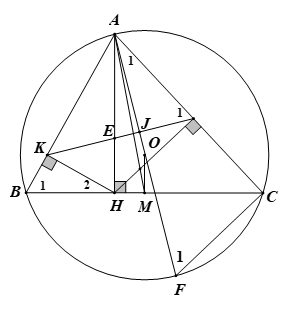
1.a) Chứng minh tứ giác \(AKHI\)nội tiếp đường tròn.
Ta có:
\(\widehat {AKH} = 90^\circ \)(vì \(HK\) vuông góc với \(AB\) tại \(K\))
\(\widehat {AIH} = 90^\circ \)(vì\(HI\) vuông góc với \(AC\) tại \(I\)).
Xét tứ giác\(AKHI\)có: \(\widehat {AKH}\,\, + \,\widehat {AIH} = 90^\circ + 90^\circ = 180^\circ \), mà hai góc này ở vị trí đối nhau.
Vậy tứ giác \(AKHI\)nội tiếp đường tròn.
b) Gọi \(E\) là giao điểm của\(AH\)với \(KI\). Chứng minh rằng \(EA.EH = EK.EI\).
Vì tứ giác \(AKHI\)nội tiếp đường tròn (cmt) nên \(\widehat {HKI} = \widehat {HAI}\)(hai góc nội tiếp cùng chắn )
Hay \(\widehat {HKE} = \widehat {IAE}\).
Xét \(\Delta EKH\) và \(\Delta EAI\)có:
\(\widehat {KEH} = \widehat {AEI}\)(hai góc đối đỉnh);
\(\widehat {HKE} = \widehat {IAE}\)(cmt)
Do đó: (g.g)
\( \Rightarrow \frac{{EK}}{{EA}} = \frac{{EH}}{{EI}} \Rightarrow EA.EH = EK.EI\)
Vậy ta có điều phải chứng minh.
c) Chứng minh \(KI\)vuông góc với \(AO\).
Kẻ đường kính \[AF\] của đường tròn \(\left( {O;R} \right)\); Gọi J là giao điểm của \(KI\) và \(AO\)
Xét đường tròn \(\left( {O;R} \right)\)có \({\widehat F_1} = {\widehat B_1}\)(hai góc nội tiếp cùng chắn cung \(AC\)). (1)
Lại có \({\widehat B_1} = {\widehat H_1}\) (vì cùng phụ với \({\widehat H_2}\)). (2)
Vì tứ giác \(AKHI\)nội tiếp đường tròn (cmt)
nên \({\widehat H_1} = {\widehat I_1}\) (hai góc nội tiếp cùng chắn cung\(AK\)) (3).
Từ (1); (2) và (3) suy ra: \(\widehat {{F_1}} = {\widehat I_1}\).
Mà trong đường tròn \(\left( {O;R} \right)\)có:\(\widehat {ACF} = 90^\circ \)(góc nội tiếp chắn nửa đường tròn).
Hay\({\widehat A_1} + {\widehat F_1} = 90^\circ \) (4).
Từ (3) và (4) suy ra \({\widehat A_1} + {\widehat I_1} = 90^\circ \)\( \Rightarrow \widehat {AJI} = 90^\circ \).
Vậy \(KI\)vuông góc với \(AO\).
d) Giả sử điểm \(A\) và đường tròn \(\left( {O;R} \right)\) cố định, còn dây \(BC\) thay đổi sao cho \(AB.AC = 3{R^2}\).
Xác định vị trí của dây cung \(BC\) sao cho tam giác \(ABC\) có diện tích lớn nhất.
Có \(\widehat {ACF} = {90^0}\) (góc nội tiếp chắn nửa đường tròn)
\(\widehat {ABH} = \widehat {AFC}\)(hai góc nội tiếp cùng chắn cung của đường tròn \(\left( {O;R} \right)\)
Xét \(\Delta AHB\) và \(\Delta ACF\)có:
\(\widehat {AHB} = \widehat {ACF}\left( {{{90}^0}} \right)\);
\(\widehat {ABH} = \widehat {AFC}\)(cmt)
Do đó: (g.g) \( \Rightarrow \frac{{AH}}{{AC}} = \frac{{AB}}{{AF}} \Rightarrow AH = \frac{{AB.AC}}{{AF}} = \frac{{3{R^2}}}{{2R}} = \frac{{3R}}{2}\)
Ta có: \({S_{ABC}} = \frac{1}{2}AH.BC = \frac{1}{2}.\frac{{3R}}{2}.BC = \frac{{3R}}{4}.BC\).
Do \(R\) không đổi nên \({S_{ABC}}\)lớn nhất \( \Leftrightarrow BC\) lớn nhất.
Gọi \(M\) là trung điểm của \(BC\) thì .
\(BC\) lớn nhất \( \Leftrightarrow OM\) bé nhất.
Ta có \(OM \ge AM - AO \ge AH - AO = \frac{{3R}}{2} - R = \frac{R}{2}\).
\(OM\) bé nhất bằng \(\frac{R}{2}\)\( \Leftrightarrow A,O,M\)thẳng hàng và \(H \equiv M\).
Khi đó \(AH = AM = AO + OM = R + \frac{R}{2} = \frac{{3R}}{2}\)
Vậy diện tích \(\Delta ABC\) lớn nhất khi \(BC\)cách \(A\) một khoảng bằng \(\frac{{3R}}{2}\) (\(\Delta ABC\) đều)
2) Gọi bán kính đáy của hình nón là \(R\).
Do diện tích của đáy hình nón là \(S = 16\pi \Rightarrow \pi {R^2} = 16\pi \Rightarrow R = 4{\rm{ }}\left( {cm} \right)\)
Theo giả thiết chiều cao của hình nón gấp 3 lần bán kính đáy nên chiều cao của hình nón là: \(h = 3R = 3.4 = 12{\rm{ }}\left( {cm} \right)\)
Thể tích hình nón là: \(V = \frac{1}{3}S.h = \frac{1}{3}.16\pi .12{\rm{ = 64}}\pi \left( {c{m^3}} \right)\)
Vậy thể tích hình nón là \({\rm{64}}\pi c{m^3}\)
Câu 2
Cho hai biểu thức \(P = \left( {\frac{{x - 6\sqrt x + 1}}{{x - 1}} - \frac{{\sqrt x - 1}}{{\sqrt x + 1}}} \right):\frac{{x + 4}}{{1 - x}}\) và \(Q = \frac{{\sqrt x }}{{x + 4}}\) (với \(x \ge 0;x \ne 1\)).
a) Tính giá trị biểu thức \(Q\) với \(x = 4\) .
b) Chứng minh rằng \(P = 4Q\).
c) Tìm tất cả các giá trị của \(x\) để \(P\) nhận giá trị là số nguyên.
Cho hai biểu thức \(P = \left( {\frac{{x - 6\sqrt x + 1}}{{x - 1}} - \frac{{\sqrt x - 1}}{{\sqrt x + 1}}} \right):\frac{{x + 4}}{{1 - x}}\) và \(Q = \frac{{\sqrt x }}{{x + 4}}\) (với \(x \ge 0;x \ne 1\)).
a) Tính giá trị biểu thức \(Q\) với \(x = 4\) .
b) Chứng minh rằng \(P = 4Q\).
c) Tìm tất cả các giá trị của \(x\) để \(P\) nhận giá trị là số nguyên.
Đăng nhập để xem lời giải
Lưu tiến độ và luyện tập hiệu quả hơn. Hoàn toàn miễn phí!
Lời giải
a) Theo bài ra \(Q = \frac{{\sqrt x }}{{x + 4}}\) với \(x \ge 0;x \ne 1\)
Thay \(x = 4\)(thỏa mãn điều kiện) vào biểu thức A ta có: \(Q = \frac{{\sqrt 4 }}{{4 + 4}} = \frac{2}{8} = \frac{1}{4}\).
b) Với \(x \ge 0;x \ne 1\) ta có:
\(P = \left( {\frac{{x - 6\sqrt x + 1}}{{x - 1}} - \frac{{\sqrt x - 1}}{{\sqrt x + 1}}} \right):\frac{{x + 4}}{{1 - x}}\)
\(P = \left[ {\frac{{x - 6\sqrt x + 1}}{{\left( {\sqrt x - 1} \right)\left( {\sqrt x + 1} \right)}} - \frac{{\sqrt x - 1}}{{\sqrt x + 1}}} \right]:\frac{{x + 4}}{{1 - x}}\)
\(p = \frac{{x - 6\sqrt x + 1 - {{\left( {\sqrt x - 1} \right)}^2}}}{{\left( {\sqrt x - 1} \right)\left( {\sqrt x + 1} \right)}}.\frac{{1 - x}}{{x + 4}}\)
\(P = \frac{{x - 6\sqrt x + 1 - x + 2\sqrt x - 1}}{{x - 1}}.\frac{{1 - x}}{{x + 4}}\)
\(P = \frac{{ - 4\sqrt x }}{{x - 1}}.\frac{{ - \left( {x - 1} \right)}}{{x + 4}}\)
\(P = \frac{{4\sqrt x }}{{x + 4}}\)
\(P = 4.\frac{{\sqrt x }}{{x + 4}} = 4.Q\)
Vậy \(P = 4Q\)với \(x \ge 0;x \ne 1\).
c) Ta có \(P = \frac{{4\sqrt x }}{{x + 4}}\) với \(x \ge 0;x \ne 1\)
Với \(x \ge 0;x \ne 1\) ta có \(4\sqrt x \ge 0;x + 4 > 0\)\( \Rightarrow P = \frac{{4\sqrt x }}{{x + 4}} \ge 0\left( 1 \right)\)
Ta cũng có: \(P = \frac{{x + 4 - \left( {x - 4\sqrt x + 4} \right)}}{{x + 4}} = 1 - \frac{{{{\left( {\sqrt x - 2} \right)}^2}}}{{x + 4}} \le 1\)với \(x \ge 0;x \ne 1\)
Do đó \(P = \frac{{4\sqrt x }}{{x + 4}} \le 1\left( 2 \right)\)
Từ \(\left( 1 \right)\)và \(\left( 2 \right)\)\( \Rightarrow 0 \le P \le 1\). Mà \(P\) nhận giá trị là số nguyên nên \(P \in \left\{ {0;1} \right\}\).
+ Với \(P = 0\)\( \Leftrightarrow \frac{{4\sqrt x }}{{x + 4}} = 0 \Leftrightarrow \sqrt x = 0 \Leftrightarrow x = 0\) (thỏa mãn)
+ Với \(P = 1\)\( \Leftrightarrow \frac{{4\sqrt x }}{{x + 4}} = 1 \Leftrightarrow x + 4 = 4\sqrt x \Leftrightarrow x + 4 - 4\sqrt x = 0 \Leftrightarrow {\left( {\sqrt x - 2} \right)^2} = 0\)
\( \Leftrightarrow \sqrt x - 2 = 0 \Leftrightarrow x = 4\) (thỏa mãn).
Vậy \(x \in \left\{ {0;4} \right\}\) thì \(P\) nhận giá trị là số nguyên
Đăng nhập để xem lời giải
Lưu tiến độ và luyện tập hiệu quả hơn. Hoàn toàn miễn phí!
Lời giải
Bạn cần đăng ký gói VIP ( giá chỉ từ 250K ) để làm bài, xem đáp án và lời giải chi tiết không giới hạn.
Đăng nhập để xem lời giải
Lưu tiến độ và luyện tập hiệu quả hơn. Hoàn toàn miễn phí!
Lời giải
Bạn cần đăng ký gói VIP ( giá chỉ từ 250K ) để làm bài, xem đáp án và lời giải chi tiết không giới hạn.
Đăng ký để học cùng Vietjack. Hoàn toàn miễn phí!
Bằng việc đăng ký, bạn đồng ý với Điều khoản sử dụng và Chính sách bảo mật của Vietjack.
 Nhắn tin Zalo
 Hỏi bài tập