






















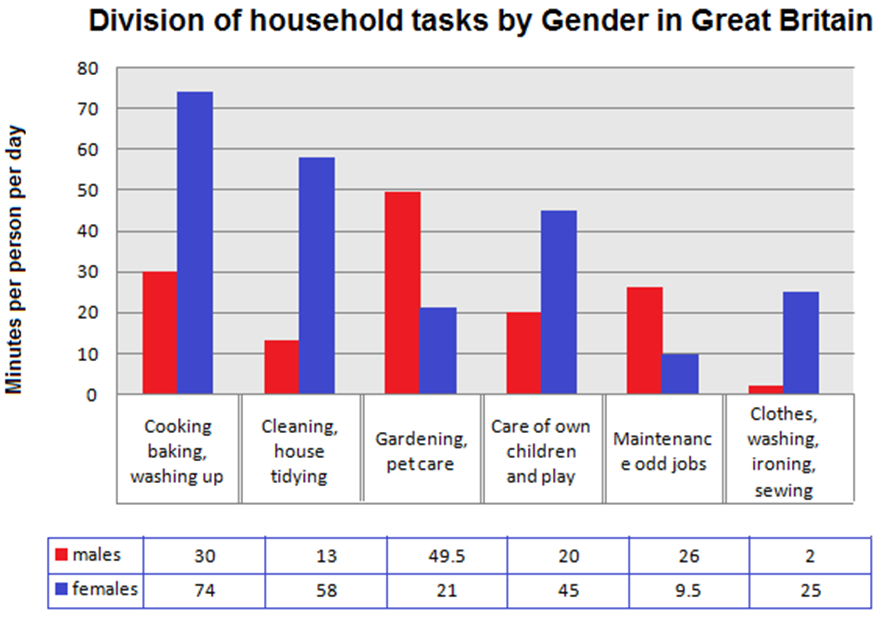
The chart shows the division of household tasks by gender in Great Britain.
Summarise the information by selecting and reporting the main features, and make comparisons where relevant. Write at least 150 words.
The chart shows the division of household tasks by gender in Great Britain.
Summarise the information by selecting and reporting the main features, and make comparisons where relevant. Write at least 150 words.
Câu hỏi trong đề: 2000 câu trắc nghiệm tổng hợp Tiếng Anh 2025 có đáp án !!
Quảng cáo
Trả lời:
 Giải bởi Vietjack
Sample 1:
The provided graph gives information on the time spent by male and female on household works in Great Britain. As is observed from the graph, female spent more time cooking, cleaning, clothing and child rearing while male spent more time on gardening and odd jobs.
According to the graph, female spend more than 200 minutes per day on household works while male spend about 140 minutes per day on those short of household jobs in Great Britain. On an average, female works more on household tasks like cooking, baking, cleaning, washing, house tidying, childcaring and sewing. For those short of jobs, women work almost 3 times than the men do. On the contrary, male work more on gardening, pet care, odd job maintaining more than women do and they spend the highest amount of time on gardening and pet caring while the female work their highest amount of time on cooking, cleaning and washing.
In conclusion, female work significantly more than men on household works like cooking, washing, cleaning and child nurturing while men spend their majority of time on household works like gardening, pet caring and odd jobs compared to the time they spend on household tasks.
Sample 2:
The bar graph portrays the division of household chores by gender in Great Britain. The unit of measurement is minutes per person per day.
Most household tasks are predominantly taken care of by women in Great Britain. Women also spend more time per day doing household work than men.
Tasks like cooking, baking, etc. are mostly taken care of by women with 74 minutes spent per person per day whereas men spend 30 minutes per person per day on such tasks. Women also significantly surpass men in cleaning, house tidying and household laundry. Women spend 45 minutes per person per day taking care of children whereas men spend 20 minutes on the same.
Men spend more time than women in gardening and pet care, where the time spent per person per day for men is 49.5 minutes, and that of women is 21 minutes. Men also spend more time doing maintenance jobs with 26 minutes per person per day, whereas women only spend 9 minutes.
Sample 3:
The bar chart compares the number of minutes which men and women (genders) on Britain spend each day on various household chores.
Overall, it is clear that women spend more time on these chores than men. Men spend more time than women on gardening/pet care and on maintenance/odd jobs, but significantly less time on all the other household tasks.
Females spend the most time on cooking baking, washing up, with a daily average of 74 minutes, compared with 30 minutes for males. There was also a noticeable difference in terms of cleaning the house and playing with the children. Women spend 58 and 45 minutes respectively each day on these activities. In contrast, men spend only 13 and 20 minutes on each of these. Men spend just 2 minutes daily average on washing/ironing clothes and sewing, much less than the 25 minutes for women.
There were only two tasks on which males spend more time than females. The figure for gardening/pet care was approximate 50 minutes for men and over 20 minutes for women. Finally, the maintenance/odd jobs were tasks which occupied the least time each day of women, at under 10 minutes, compared with 26 minutes for men.
Sample 4:
The bar chart illustrates how much time marriage partners from the UK spent on household chore.
Overall, women generally do much more housework than men, with only the exception of gardening, pet care and repairing tasks. Besides, women spend time in the kitchen more than the other activities.
First, the figures for females are exceptionally high in specific tasks such as cooking, cleaning, childcare which are over 70, just below 60, roughly 45. In contrast, the amounts of time in the males group are underwhelmingly low in comparison, which are 30, slightly above 10 and 20, in the same order. Moreover, men spend almost no time (only 2 minutes) for clothes chores.
On the other hand, the remaining activities like gardening, taking care of pet and maintenance odd jobs are mainly done by men, with the figures being nearly 50 minutes and over 25 minutes respectively. Regarding the females group, the data are lower than half of the figures for males.
Sample 5:
The chart shows the average number of minutes per day men and women in Great Britain spend on jobs around the house.
In total, men spend just over two-and-a-half hours on household tasks whereas women spend slightly less than four hours. Women spend more than twice as much time doing kitchen tasks such as cooking and washing up as men (74 minutes for women as opposed to 30 minutes for men. Women are also more active in cleaning the house- it takes 58 minutes of their day compared to / with 13 minutes for men – and childcare, where women put in more than twice as much time as men.
On the other hand, men are more active in gardening and pet care, where they spend twice as long as women, and maintenance and DIY, on which they spend 15 minutes more than women. Women account for almost all the time spent on washing and ironing clothes. This takes them 25 minutes, while / whereas men spend just 2 minutes on this task.
Overall, the figures show that women spend more time on routine domestic chores than men, while / whereas men do more household maintenance, gardening and pet care.
Sample 6:
The bar graph delineates the division of household tasks by gender in Great Britain, presenting a clear disparity in time allocation between males and females for various domestic activities.
At a glance, the overview indicates that females in Great Britain undertake a significantly greater portion of cooking, cleaning, and child-related tasks compared to males. Conversely, males predominate in activities such as gardening and performing odd jobs around the house.
Delving into specifics, females lead substantially in the kitchen, dedicating an average of 74 minutes per day to cooking, baking, and washing up, more than double the time spent by males. This trend of female dominance continues with cleaning and house tidying, where females invest 58 minutes daily, compared to just 13 minutes by their male counterparts. Childcare is another area where females are the primary contributors, spending 45 minutes per day, which is more than double the male contribution.
In contrast, the division of household tasks by gender in Great Britain shifts as we consider outdoor and less routine tasks. Males dedicate nearly 50 minutes to gardening and pet care, surpassing females by a significant margin. Similarly, when it comes to maintenance and odd jobs, males allocate more than twice the time females do. The only domain where both genders show minimal difference in time investment is clothing maintenance, including washing, ironing, and sewing, with females spending marginally more time.
Sample 7:
The chart in question documents the division of household tasks by gender in Great Britain, quantifying the daily minutes each sex dedicates to various domestic duties.
The overview unveils a pronounced imbalance in the division of household tasks by gender in Great Britain, with women bearing a heavier burden in indoor chores, while men are more engaged in outdoor and ad-hoc tasks. Notably, tasks related to cooking and cleaning are predominantly assumed by females, whereas gardening and maintenance are male-dominated domains.
Examining the data in finer detail, the disparity is stark in culinary and sanitation responsibilities. Women invest an average of 74 minutes per day in cooking, baking, and related cleanup, a figure which more than doubles the male investment in these tasks. Additionally, when it comes to tidying up the home, women allocate nearly an hour, dwarfing the male contribution of a mere 13 minutes. Childcare also follows this pattern, with females contributing 45 minutes daily - a figure that is again significantly higher than that of their male counterparts.
The division of household tasks by gender in Great Britain takes a turn when examining fewer routine tasks. Men devote approximately 49.5 minutes to gardening and pet care, a domain where they surpass women by a considerable margin. Odd jobs and maintenance also see men investing more time, with a notable 26 minutes per day, which is nearly triple the time spent by women. The graph does reveal a closer parity in tasks pertaining to clothing maintenance, with a slight inclination towards more female participation.
Sample 8:
The bar chart meticulously enumerates the division of household tasks by gender in Great Britain, showcasing the average time men and women spend on various domestic chores.
From an overarching perspective, the division of household tasks by gender in Great Britain reveals a traditional split in domestic labor. Women are the primary contributors to indoor tasks such as cooking, cleaning, and child rearing, whereas men allocate more time to outdoor and intermittent tasks such as gardening and maintenance.
Zooming in on the details, the chart indicates a significant gender disparity in the realm of kitchen activities, with women spending 74 minutes per day on cooking and cleaning up, contrasting with men's 30 minutes. Furthermore, women dedicate nearly an hour daily to cleaning and house tidying, which is significantly higher than the 13 minutes contributed by men. When it comes to nurturing and caring for children, women's involvement is substantial, at 45 minutes, compared to men's 20 minutes.
In terms of less frequent household duties, the division of household tasks by gender in Great Britain tilts towards men. Gardening and pet care see men spending almost 50 minutes each day, markedly more than the 21 minutes by women. For maintenance and odd jobs, men's involvement is nearly triple that of women's. Notably, the gap narrows concerning clothes maintenance, with women's time slightly eclipsing men's.
Sample 9:
The bar chart portrays the division of household tasks by gender in Great Britain, charting the minutes per day each gender devotes to a range of domestic duties.
The immediate takeaway from the chart is the uneven division of household tasks by gender in Great Britain, with women disproportionately shouldering indoor chores, and men more engaged in outdoor and sporadic tasks. This differential allocation is most evident in the spheres of cooking, cleaning, and childcare for women, and gardening and maintenance for men.
Detailing the division further, the graph illuminates that women in Great Britain spend 74 minutes per day on cooking, baking, and washing up, more than double the time men dedicate to these tasks. In cleaning and house tidying, women's daily efforts amount to 58 minutes, quadruple that of men's 13 minutes. Additionally, in the nurturing role of childcare, women average 45 minutes per day, markedly outpacing the male contribution.
Conversely, the division of household tasks by gender in Great Britain leans in favor of men when it comes to outdoor activities. Men allocate 49.5 minutes to gardening and pet care, an arena where their efforts surpass those of women. In the maintenance of odd jobs, men's dedication is also pronounced, investing 26 minutes daily, starkly contrasting with women's 9.5 minutes. However, in clothing care, which includes washing, ironing, and sewing, the gender time investment is more comparable, with women slightly ahead.
Sample 10:
The bar chart shows the average number of minutes per day men and women in Great Britain spend on jobs around the house. The trend suggests that women do more of the household chores compared to men.
According to the information shown, men only spend two-and-a-half hours on household tasks, whereas women spend slightly more than four hours. Women spend more than twice as much time doing kitchen tasks at 74 minutes compared to men who only do 30 minutes. This is a difference of more than double. Women are also more active in cleaning the house. 58 minutes of their day is spent cleaning, compared to only 13 minutes for men. Similarly, women put in more than twice as much time as men for childcare, with 25 more minutes of this kind of care being provided by women.
On the other hand, men are more active in the garden and with pet care, where they spend twice as much time as women. For maintenance and odd jobs around the house, men spend 15 minutes more than women do. Women account for almost all the time spent on washing and ironing clothes with a significant difference of 23 minutes spent on these chores by women. In fact, men spend only two minutes on this task.
Overall, the information shows that women spend more time on routine domestic chores than men, while men do more household maintenance, gardening and pet care.
Sample 11:
The bar chart details how household chores in Great Britain are divided between males and females. The chart illustrates a distinct gender disparity in the division of household tasks in Great Britain, with females generally spending more time on indoor chores such as cooking and cleaning, while males are more involved in outdoor activities like gardening and maintenance work.
It is immediately evident that cooking, baking, and washing up are predominantly undertaken by females, who spend an average of 74 minutes per day on these tasks, compared to just 30 minutes by their male counterparts. Similarly, females dedicate more time to cleaning and tidying up, with 58 minutes per day, which is significantly higher than the 13 minutes spent by males. In the realm of gardening and pet care, men spend approximately 49.5 minutes per day, surpassing women who allocate about 21 minutes to these tasks.
When it comes to childcare, females again take the lead, investing 45 minutes daily in the care and play of children, which is more than double the time spent by males, at 20 minutes. However, for maintenance and odd jobs, the roles reverse with men spending 26 minutes per day as opposed to women who contribute a comparatively lesser 9.5 minutes.
The last category, which includes clothes washing, ironing, and sewing, once more sees females spending more time, at 25 minutes per day, compared to a mere 2 minutes for males.
Sample 12:
The chart given above shows the average number of minutes per day British men and women spend in doing domestic tasks. In short, women spend about four hours in doing household tasks while men spend less than two and half hours.
The tasks that are more likely to be done by women than men include cooking, cleaning, washing and childcare. While women spend 74 minutes in doing tasks like cooking, baking and washing up, men spend just 30 minutes. Women are also far more active than men when it comes to doing tasks like cleaning and house tidying (58 minutes per day for women as opposed to just 13 minutes for men). The areas where men are more active than women are gardening, pet care and odd maintenance jobs around the house. On an average, men spend 49.5 minutes per day in gardening and pet care whereas women spend 21 minutes on these tasks.
Women spend twice as much time as men on childcare. They also account for nearly all the time spend on tasks like washing, ironing and sewing (25 minutes for women as opposed to just 2 minutes for men).
Overall, the chart shows that routine domestic chores are mainly done by women, while men prefer doing tasks like household maintenance, gardening and pet care.
Sample 13:
The chart shows the number of minutes per day spent by British men and women in doing household tasks. On an average, the women spend about four hours doing household tasks whereas the men spend less than two and half hours.
The tasks on which women spend more time than men include cooking, cleaning house, taking care of the children and laundry. In doing all these tasks, women spend approximately 200 minutes which is almost three times the time spent by men in these tasks. On the other hand, men spend twice the time than women in doing tasks like gardening and maintenance of odd jobs in the house. Men spend the highest time, almost 50 minutes, in gardening and petcare. While the women spend only 30 minutes for these tasks. The time spent by men in washing, ironing and sewing clothes is as low as 2 minutes per day as opposed to 25 minutes spent by women.
In short, women spend far more time doing household chores than men whilst men prefer to do gardening, petcare and maintaining odd jobs.
Sample 14:
The chart shows the division of household tasks by gender in Great Britain.
The chart statistically summarizes the average time it takes for men and women to do their daily chores at home in Great Britain.
The Office for National Statistics analyzes that women make up the large proportion of the time for jobs relating to cooking, baking, washing up, ironing, sewing, and caring their children. Meanwhile, men take charge of sweaty manual jobs such as gardening, pet care (49.5 minutes) or maintenance odd jobs (26 minutes). Taking job of cooking, baking and washing up for the example, it is the most time which women spend on with 74 minutes daily. The second most time spending is for cleaning, house tidying with 58 minutes. The author’s analysis of this data yields several key findings.
First, this data allows readers to look into detail the inequality between men and women. In general, though the statistics illustrates that men do help women in some household activities, the comparison of time between men and women is far equal. Men use less than one hour (slightly 49.5 minutes), and women use more than one hour (74 minutes) per day to share their marriage responsibility.
Second, the chart conjures up an image about a change in the men’s once mindset which household tasks sole belonged to women’s responsibility that was considered as a discrimination in society. Men can also share some daily housing activities with their partner, such as: 30 minutes for cooking, baking, washing up; 13 minutes for cleaning, housing tidying; 49.5 minutes, 20 minutes, and 26 minutes for gardening, pet care, care of own children and play, maintenance odd jobs, respectively. The most noticeable in the presentation is men the least like the job of clothes, washing, ironing, sewing (2 minutes).
Overall, the figures show that men would love to do daily routines which need more strength. Women much enjoy caring activities.
Sample 15:
The chart provides information about the division of household tasks by gender in Great Britain and the number of minutes per day spent by both males as well as females in doing various tasks. On an average, women spend approximately four hours doing the household tasks, whereas men spend less than two and half hours for the same. The tasks on which women spend more time than men include cooking, cleaning the house, taking care of the children and laundry. In doing all these tasks, women spend approximately 200 minutes which is almost three times the time spent by men in accomplishing these tasks. On the other hand, men spend twice the time than women in doing tasks like gardening and maintenance of odd jobs in the house. Men spend majority of their time, almost 50 minutes, in gardening and pet care whereas women spend only 30 minutes for these tasks. The time spent by men in washing, ironing and sewing clothes is as low as 2 minutes per day as opposed to 25 minutes spent by women. In a nutshell, women spend far more time when it comes to doing household chores than men who prefer to do gardening, pet care and maintenance of odd jobs.
Hot: 1000+ Đề thi cuối kì 2 file word cấu trúc mới 2026 Toán, Văn, Anh... lớp 1-12 (chỉ từ 60k). Tải ngay
CÂU HỎI HOT CÙNG CHỦ ĐỀ
Lời giải
Sample 1:
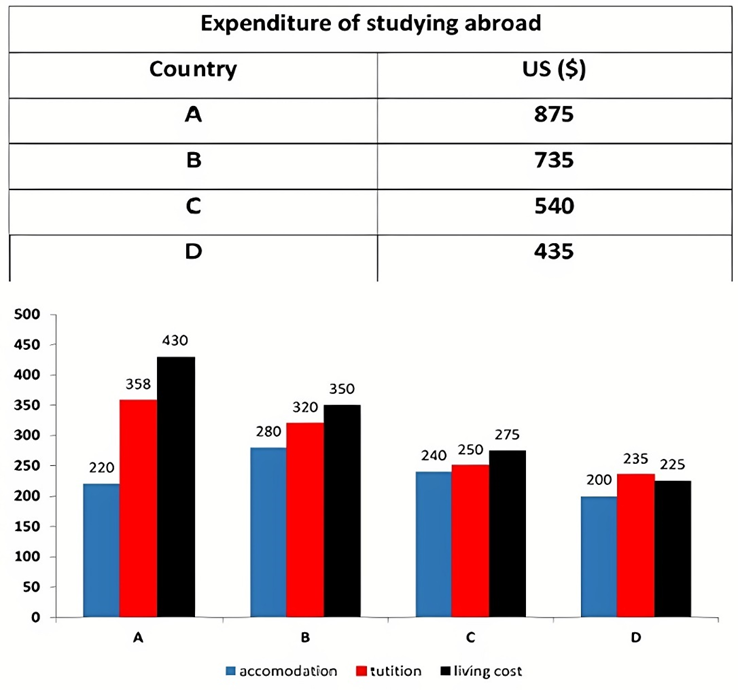
The bar graph illustrates the overseas students' spending on accommodation, tuition, and living expenses, while the table depicts information about the average weekly expenses by international students in four countries: A, B, C, and D.
Overall, foreign students need to spend the highest in country A and the lowest in D. In nearly every nation, the international students’ weekly average living expenses are the greatest, while their housing cost registers the lowest.
The costliest country for studying is A, with a weekly average expense of 875 dollars. This is followed by B, C, and D, which have weekly expenses of 735, 540, and 435 dollars, respectively. However, foreign students always pay the least for accommodation, which incurs on average weekly 220, 280, 240, and 200 dollars in the nations A, B, C, and D, respectively.
On the other hand, living expenditures account for the highest portion of average weekly costs for international students in countries A, B, and C, with 430, 350, and 275 dollars, correspondingly. Tuition fees in the same countries (A, B and C) come in second with the weekly averages of 358, 320, and 250 dollars in order. However, D is the only nation where education accounts for the highest average spending area, coming in at USD 235, followed by the cost of living (USD 225) and housing (USD 200).
Sample 2:
The table illustrates information regarding the weekly spendings by overseas students in four countries, A, B, C and D, while the bar graph depicts the students’ expenditure on the sectors, housing, education fees and living expenses.
Overall, the cost of studying abroad is the highest in country A and the lowest in D. Apart from country D, living costs account for the most part of the weekly spendings in all countries, while accommodation registers the least.
Regarding the total cost of studying, A is the most expensive country with weekly average 875 dollars, followed by B, C and D with 735, 540 and 435 dollars, respectively. On the other hand, the overseas students always spend the least on accommodation, which are on average weekly 220, 280, 240 and 200 dollars in the corresponding countries A, B, C and D.
Considering the living cost, it takes the largest share of foreign students’ average weekly expenses in countries A, B, and C with 430, 350 and 275 dollars, respectively, while tuition fees in the same countries hold the second place with weekly average 358, 320 and 250 dollars, sequentially. However, D is the only country where tuition fee occupies the highest expenditure with average weekly 235 dollars, followed by living cost (USD 225) and accommodation (USD 200.)
Sample 3:
The table and bar graph depict information regarding the weekly spendings by overseas students in countries A, B C and D.
Overall, there are three elements, housing, school fees and living costs that contribute to the total weekly spendings. The total expenditure in country A is the highest while it is the lowest in country D. Living costs account for the most part of the weekly spendings in all countries except D.
The total mean weekly cost for pupils to study in country A is US$875, next by country B at US$735, and then by country C at US$540, and finally by country D at US$435. The living costs are always the biggest component of the expenditure except for country D, with about US$10 less than the major spending which is the school fees.
Accommodation accounts for the least among all spendings in all countries. The most expensive housing is found in country B, at US$280, and the cheapest in country D at US$200. The middle range can be seen in country A at US$220 and country C at US$240, respectively. Costs of the tuition fee range between US$ 358 and US$235 in country A and D, in order.
Lời giải
Sample 1:
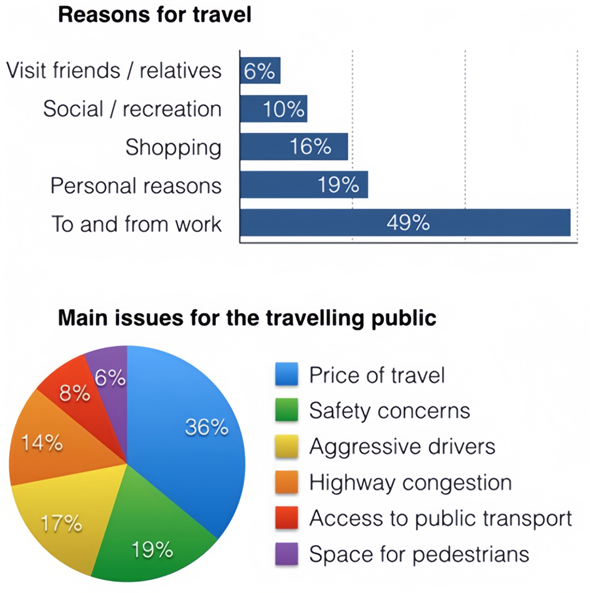
The bar chart and pie chart give information about why US residents travelled and what travel problems they experienced in the year 2009.
It is clear that the principal reason why Americans travelled in 2009 was to commute to and from work. In the same year, the primary concern of Americans, with regard to the trips they made, was the cost of travelling.
Looking more closely at the bar chart, we can see that 49% of the trips made by Americans in 2009 were for the purpose of commuting. By contrast, only 6% of trips were visits to friends or relatives, and one in ten trips were for social or recreation reasons. Shopping was cited as the reason for 16% of all travel, while unspecific ‘personal reasons’ accounted for the remaining 19%.
According to the pie chart, price was the key consideration for 36% of American travellers. Almost one in five people cited safety as their foremost travel concern, while aggressive driving and highway congestion were the main issues for 17% and 14% of the travelling public. Finally, a total of 14% of those surveyed thought that access to public transport or space for pedestrians were the most important travel issues.
Sample 2:
The bar chart compares the figures for Americans going out for five reasons and the pie chart illustrates the percentage of six problems that concerned them when travelling in 2009. Overall, it is clear that the main reason why people in the US went out in 2009 is to commute to work, and the cost of travelling is the problem concerning them the most.
Looking first at the bar graph, the proportion of Americans going out for commuting to work stood at 49%, while the figure for those leaving their house for personal reasons accounted for 19%. In addition, the rate of people in the US going out for shopping and recreation made up 16% and 10%, respectively, while visiting friends or relatives accounted for the lowest percentage, at only 6%.
Turning to the pie chart, the cost of travelling was the most concerning problem of Americans when going out, with the figure making up 36%, while the proportion of safety concerns is half of that, at 19%. In addition, 17% of US citizens were concerned about aggressive drivers, while highway congestion made 14% of them worried when leaving their house. Access to public transportation and places for people to walk accounted for the lowest percentages, at only 8% and 6%, respectively.
Sample 3:
The provided charts offer insights into the reasons for travel and the primary concerns faced by the traveling public in the United States during the year 2009. The data is presented through a bar chart illustrating travel purposes and a pie chart highlighting key issues.
Notably, the primary motivation for travel among Americans in 2009 was commuting to and from work. Simultaneously, the major concern for the traveling public during their trips revolved around the cost associated with travel.
Examining the bar chart in detail reveals that almost half of the trips made by Americans in 2009, precisely 49%, were attributed to commuting. Conversely, visits to friends or relatives accounted for a mere 6%, while social or recreational trips constituted one in ten journeys. Shopping emerged as the purpose for 16% of all travel, leaving the remaining 19% for unspecific ‘personal reasons.’
Turning attention to the pie chart, it becomes evident that cost was the primary consideration for 36% of American travelers. Safety closely followed, with nearly one in five people, or 19%, expressing it as their foremost travel concern. Aggressive driving and highway congestion were significant issues for 17% and 14% of the traveling public, respectively. Additionally, 14% of respondents identified access to public transport or space for pedestrians as the most crucial travel issues.
Sample 4:
The bar chart shows why American people chose to travel, and the pie chart shows the main issues for the travelling public in the USA, both for 2009. The trend suggests that the reason and price were the main issues for travel in the United States. It is clear that commuting from work was reported as the biggest contribution to travel, at 49%. People who went travelling for personal reasons and shopping accounted for 35% when these two groups are combined. However, interaction with friends and relatives only accounted for 25% less than the above categories. And social and recreational activities took up only 6%, which was the lowest figure by more than 43%. The travelling public’s main issues were related to price and safety, with 55% of respondents reporting these two issues. While other issues accounted for a relatively small part. Only 17% of the respondents reported issues with aggressive drivers, while highway congestion accounted for even less at 14% of the issues reported. The percentage of access to public transport and space for pedestrians was much lower than the other categories at less than 10% for both. To conclude, price and commuting time were the dominant factors relating to travel in the US in 2009.
Lời giải
Bạn cần đăng ký gói VIP ( giá chỉ từ 250K ) để làm bài, xem đáp án và lời giải chi tiết không giới hạn.
Lời giải
Bạn cần đăng ký gói VIP ( giá chỉ từ 250K ) để làm bài, xem đáp án và lời giải chi tiết không giới hạn.
Lời giải
Bạn cần đăng ký gói VIP ( giá chỉ từ 250K ) để làm bài, xem đáp án và lời giải chi tiết không giới hạn.
Lời giải
Bạn cần đăng ký gói VIP ( giá chỉ từ 250K ) để làm bài, xem đáp án và lời giải chi tiết không giới hạn.
Lời giải
Bạn cần đăng ký gói VIP ( giá chỉ từ 250K ) để làm bài, xem đáp án và lời giải chi tiết không giới hạn.
 Nhắn tin Zalo
 Hỏi bài tập