






















The incredible growth of the Internet over recent years has caused problems for parents and teachers. Parents worry about which sites their children spend time on, who they chat to online and the possible effects that computer games might have on them. For teachers, meanwhile, the main worry is the way the Internet makes cheating easier!
Schools and universities say there has been a huge increase in plagiarism – taking other people’s words and ideas and pretending that they are your own. In the past, anyone who wanted to copy had to go to a library, find the right books, read through them, find the sections they needed and then physically write down the words they wanted to use. Nowadays, though, students can simply copy extracts from websites- while really desperate students sometimes copy whole essays! As if this wasn’t bad enough, sites offering to actually do homework – at a price – have also started appearing.
Despite all this, we shouldn’t assume that the Internet only brings problems. Indeed, you could say that for every problem the Internet creates, it also brings a solution. Parents can now use sophisticated controls to stop kids accessing sites that might do them harm, while new software helps teachers to detect copied work immediately. Many, of course, are already able to recognize when someone is cheating! “Some students suddenly start using words they can’t possibly understand like dialectical antagonism”, explains one teacher, “or parts of their essays feel different.”
One of the hardest things for teachers today is deciding how to mix modern technology with traditional study skills – and how best to use the Web in class. As more and more schools install computers in every classroom, the role of the teacher is changing. Making sure students don’t just copy things and do learn how to quote copied work properly is part of their job, but so is designing suitable projects to fully exploit the Web in helping students learn about subjects and develop their life and social skills.
(Adapted from Pre-Intermediate Outcomes by Hugh Della $ Andrew Walkley)
The incredible growth of the Internet over recent years has caused problems for parents and teachers. Parents worry about which sites their children spend time on, who they chat to online and the possible effects that computer games might have on them. For teachers, meanwhile, the main worry is the way the Internet makes cheating easier!
Schools and universities say there has been a huge increase in plagiarism – taking other people’s words and ideas and pretending that they are your own. In the past, anyone who wanted to copy had to go to a library, find the right books, read through them, find the sections they needed and then physically write down the words they wanted to use. Nowadays, though, students can simply copy extracts from websites- while really desperate students sometimes copy whole essays! As if this wasn’t bad enough, sites offering to actually do homework – at a price – have also started appearing.
Despite all this, we shouldn’t assume that the Internet only brings problems. Indeed, you could say that for every problem the Internet creates, it also brings a solution. Parents can now use sophisticated controls to stop kids accessing sites that might do them harm, while new software helps teachers to detect copied work immediately. Many, of course, are already able to recognize when someone is cheating! “Some students suddenly start using words they can’t possibly understand like dialectical antagonism”, explains one teacher, “or parts of their essays feel different.”
One of the hardest things for teachers today is deciding how to mix modern technology with traditional study skills – and how best to use the Web in class. As more and more schools install computers in every classroom, the role of the teacher is changing. Making sure students don’t just copy things and do learn how to quote copied work properly is part of their job, but so is designing suitable projects to fully exploit the Web in helping students learn about subjects and develop their life and social skills.
(Adapted from Pre-Intermediate Outcomes by Hugh Della $ Andrew Walkley)What does the word them in paragraph 1 refer to?
Quảng cáo
Trả lời:
 Giải bởi Vietjack
Đáp án đúng là B
Phương pháp giải
Thông tin: Parents worry about which sites their children spend time on, who they chat to online and the possible effects that computer games might have on them.
Lời giải
Từ them trong đoạn 1 ám chỉ điều gì?
A. cha mẹ
B. trẻ em
C. trò chơi
D. giáo viên
Thông tin: Parents worry about which sites their children spend time on, who they chat to online and the possible effects that computer games might have on them.
Tạm dịch: Các bậc phụ huynh lo lắng về việc con cái họ dành thời gian vào những trang web nào, trò chuyện với ai trực tuyến và những ảnh hưởng có thể xảy ra của trò chơi máy tính đối với chúng.
Câu hỏi cùng đoạn
Câu 2:
How do students commit plagiarism?
How do students commit plagiarism?
Giải bởi Vietjack
Đáp án đúng là C
Phương pháp giải
Đọc hiểu tìm thông tin đoạn 2
Lời giải
Học sinh phạm tội đạo văn như thế nào?
A. Tham khảo bài viết của người khác
B. Nhờ một số trang web làm hộ bài tập về nhà
C. Sao chép bài luận của người khác
D. Giả vờ là bậc thầy về viết lách
Thông tin: Schools and universities say there has been a huge increase in plagiarism – taking other people’s words and ideas and pretending that they are your own.
Tạm dịch: Các trường học và trường đại học cho biết tình trạng đạo văn - lấy lời văn và ý tưởng của người khác rồi giả vờ như đó là của mình - đã gia tăng đáng kể.
Câu 3:
What is mentioned about teachers in paragraph 3?
What is mentioned about teachers in paragraph 3?
Giải bởi Vietjack
Đáp án đúng là B
Phương pháp giải
Đọc hiểu tìm thông tin đoạn 3
Lời giải
Đoạn 3 đề cập gì về giáo viên?
A. Họ có thể hạn chế học sinh đánh giá các trang web có hại.
B. Họ có thể theo dõi các nguồn mà học sinh sao chép.
C. Họ không thể nhận ra hành vi gian lận nếu không sử dụng phần mềm
D. Họ yêu cầu học sinh giải thích từ ngữ ở trên trình độ của học sinh.
Thông tin: Parents can now use sophisticated controls to stop kids accessing sites that might do them harm, while new software helps teachers to detect copied work immediately. Many, of course, are already able to recognize when someone is cheating! “Some students suddenly start using words they can’t possibly understand like dialectical antagonism”, explains one teacher, “or parts of their essays feel different.”
Tạm dịch: Cha mẹ hiện có thể sử dụng các biện pháp kiểm soát tinh vi để ngăn trẻ em truy cập vào các trang web có thể gây hại cho chúng, trong khi phần mềm mới giúp giáo viên phát hiện ngay lập tức bài làm bị sao chép. Tất nhiên, nhiều người đã có thể nhận ra khi ai đó gian lận! "Một số học sinh đột nhiên bắt đầu sử dụng những từ mà chúng không thể hiểu được như đối kháng biện chứng", một giáo viên giải thích, "hoặc một số phần trong bài luận của chúng có cảm giác khác biệt".
Câu 4:
What is the word “ detect” in paragraph 3 closest in meaning to?
Giải bởi Vietjack
Đáp án đúng là B
Phương pháp giải
Từ vựng (detect (v) phát hiện)
Lời giải
Từ “detect” trong đoạn 3 có nghĩa gần nhất với từ nào?
A. ignore (v) phớt lờ
B. notice (v) phát hiện, chú ý
C. adore (v) yêu thích
D. confide (v) tự tin
=> detect = notice
Thông tin: Parents can now use sophisticated controls to stop kids accessing sites that might do them harm, while new software helps teachers to detect copied work immediately.
Tạm dịch: Cha mẹ hiện có thể sử dụng các biện pháp kiểm soát tinh vi để ngăn trẻ em truy cập vào các trang web có thể gây hại cho chúng, trong khi phần mềm mới giúp giáo viên phát hiện ngay các bài tập sao chép.
Câu 5:
Which of the following would the author most likely support?
Giải bởi Vietjack
Đáp án đúng là C
Phương pháp giải
Đọc hiểu toàn bài và suy luận
Lời giải
Tác giả có khả năng ủng hộ quan điểm nào sau đây nhất?
A. Cách áp dụng phương pháp học tập kết hợp là một thách thức mới đối với giáo viên.
B. Giáo viên không nên cho phép học sinh lợi dụng bài tập sao chép.
C. Internet có thể được sử dụng tích cực trong giáo dục.
D. Vai trò của giáo viên trở nên ít quan trọng hơn khi các thiết bị hiện đại hơn xuất hiện trong lớp học.
Thông tin: Making sure students don’t just copy things and do learn how to quote copied work properly is part of their job, but so is designing suitable projects to fully exploit the Web in helping students learn about subjects and develop their life and social skills.
Tạm dịch: Đảm bảo học sinh không chỉ sao chép mà còn học cách trích dẫn đúng tác phẩm đã sao chép là một phần công việc của họ, nhưng việc thiết kế các dự án phù hợp để khai thác tối đa Web trong việc giúp học sinh tìm hiểu về các môn học và phát triển các kỹ năng sống và xã hội cũng vậy.
Đăng nhập để xem lời giải
Lưu tiến độ và luyện tập hiệu quả hơn. Hoàn toàn miễn phí!
Đang tải chế độ Học...
Hot: 1000+ đề thi giữa kì 1 lớp 1-12 đầy đủ các môn (Update 2026) (chỉ từ 60k). Tải ngay
CÂU HỎI HOT CÙNG CHỦ ĐỀ
Câu 1
Đăng nhập để xem lời giải
Lưu tiến độ và luyện tập hiệu quả hơn. Hoàn toàn miễn phí!
Lời giải
Đáp án đúng là D
Phương pháp giải
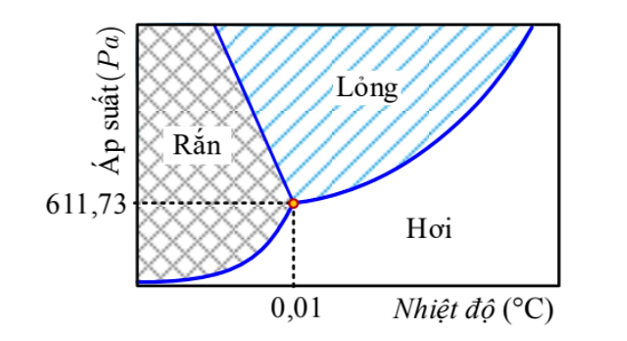
Phân tích đồ thị hình vẽ.
Dựa vào lí thuyết sự chuyển thể của chất.
Lời giải
Dựa vào đồ thị trên ta có:
Giữ nguyên áp suất, nếu tăng nhiệt độ hệ chuyển thành thể hơi.
Giữ nguyên áp suất, nếu giảm nhiệt độ, hệ chuyển thành thể rắn.
Giữ nguyên nhiệt độ, tăng áp suất, hệ chuyển thành thể lỏng.
Giữ nguyên nhiệt độ, giảm áp suất, hệ chuyển thành thể hơi.
Vậy đáp án sai là D.
Đăng nhập để xem lời giải
Lưu tiến độ và luyện tập hiệu quả hơn. Hoàn toàn miễn phí!
Lời giải
Đáp án đúng là "168"
Phương pháp giải
Ứng dụng tích phân
Lời giải
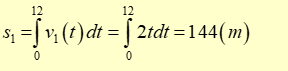
Quãng đường ô tô đi được từ lúc lăn bánh đến khi được phanh:
Vận tốc \({v_2}\left( t \right)\left( {m/s} \right)\) của ô tô từ lúc được phanh đến khi dừng hẳn thỏa mãn:
\({v_2}\left( t \right) = \mathop \smallint \nolimits^ - 12dt = - 12t + C\),
\({v_2}\left( {12} \right) = {v_1}\left( {12} \right) = 24 \Rightarrow C = 168 \Rightarrow {v_2}\left( t \right) = - 12t + 168\left( {{\rm{m}}/{\rm{s}}} \right)\)
Thời điểm xe dừng hẳn tương ứng với thỏa mãn \({v_2}\left( t \right) = 0 \Leftrightarrow t = 14\left( s \right)\)
Quãng đường ô tô đi được từ lúc xe được phanh đến khi dừng hẳn là:
\({s_2} = \int\limits_{12}^{14} {{v_2}\left( t \right)dt} = \int\limits_{12}^{14} {\left( { - 12t + 168} \right)dt} = 24m\)
Quãng đường cần tính \(s = {s_1} + {s_2} = 144 + 24 = 168\left( m \right)\)
Câu 3
Đăng nhập để xem lời giải
Lưu tiến độ và luyện tập hiệu quả hơn. Hoàn toàn miễn phí!
Lời giải
Bạn cần đăng ký gói VIP ( giá chỉ từ 250K ) để làm bài, xem đáp án và lời giải chi tiết không giới hạn.

Đăng nhập để xem lời giải
Lưu tiến độ và luyện tập hiệu quả hơn. Hoàn toàn miễn phí!
Lời giải
Bạn cần đăng ký gói VIP ( giá chỉ từ 250K ) để làm bài, xem đáp án và lời giải chi tiết không giới hạn.
Đăng nhập để xem lời giải
Lưu tiến độ và luyện tập hiệu quả hơn. Hoàn toàn miễn phí!
Lời giải
Bạn cần đăng ký gói VIP ( giá chỉ từ 250K ) để làm bài, xem đáp án và lời giải chi tiết không giới hạn.
Đăng nhập để xem lời giải
Lưu tiến độ và luyện tập hiệu quả hơn. Hoàn toàn miễn phí!
Lời giải
Bạn cần đăng ký gói VIP ( giá chỉ từ 250K ) để làm bài, xem đáp án và lời giải chi tiết không giới hạn.
Câu 7
Đăng nhập để xem lời giải
Lưu tiến độ và luyện tập hiệu quả hơn. Hoàn toàn miễn phí!
Lời giải
Bạn cần đăng ký gói VIP ( giá chỉ từ 250K ) để làm bài, xem đáp án và lời giải chi tiết không giới hạn.
Đăng ký để học cùng Vietjack. Hoàn toàn miễn phí!
Bằng việc đăng ký, bạn đồng ý với Điều khoản sử dụng và Chính sách bảo mật của Vietjack.
 Nhắn tin Zalo
 Hỏi bài tập