






















Being aware of one's own emotions - recognizing and acknowledging feelings as they happen - is at the very heart of Emotional Intelligence. And this awareness encompasses not only moods but also thoughts about those moods. People who are able to monitor their feelings as they arise are less likely to be ruled by them and are thus better able to manage their emotions.
Managing emotions does not mean suppressing them; nor does it mean giving free rein to every feeling. Psychologist Daniel Goleman, one of several authors who have popularized the notion of Emotional Intelligence, insisted that the goal is balance and that every feeling has value and significance. As Goleman said, "A life without passion would be a dull wasteland of neutrality, cut off and isolated from the richness of life itself." Thus, we manage our emotions by expressing them in an appropriate manner. Emotions can also be managed by engaging in activities that cheer us up, soothe our hurts, or reassure us when we feel anxious.
Clearly, awareness and management of emotions are not independent. For instance, you might think that individuals who seem to experience their feelings more intensely than others would be less able to manage them. However, a critical component of awareness of emotions is the ability to assign meaning to them - to know why we are experiencing a particular feeling or mooD. Psychologists have found that, among individuals who experience intense emotions, individual differences in the ability to assign meaning to those feelings predict differences in the ability to manage them. In other words, if two individuals are intensely angry, the one who is better able to understand why he or she is angry will also be better able to manage the anger.
Self-motivation refers to strong emotional self-control, which enables a person to get moving and pursue worthy goals, persist at tasks even when frustrated, and resist the temptation to act on impulse. Resisting impulsive behavior is, according to Goleman, "the root of all emotional self- control."
Of all the attributes of Emotional Intelligence, the ability to postpone immediate gratification and to persist in working toward some greater future gain is most closely related to success - whether one is trying to build a business, get a college degree, or even stay on a diet. One researcher examined whether this trait can predict a child's success in school. The study showed that 4-year-old children who can delay instant gratification in order to advance toward some future goal will be “far superior as students” when they graduate from high school than will 4-year-olds who are not able to resist the impulse to satisfy their immediate wishes.
Being aware of one's own emotions - recognizing and acknowledging feelings as they happen - is at the very heart of Emotional Intelligence. And this awareness encompasses not only moods but also thoughts about those moods. People who are able to monitor their feelings as they arise are less likely to be ruled by them and are thus better able to manage their emotions.
Managing emotions does not mean suppressing them; nor does it mean giving free rein to every feeling. Psychologist Daniel Goleman, one of several authors who have popularized the notion of Emotional Intelligence, insisted that the goal is balance and that every feeling has value and significance. As Goleman said, "A life without passion would be a dull wasteland of neutrality, cut off and isolated from the richness of life itself." Thus, we manage our emotions by expressing them in an appropriate manner. Emotions can also be managed by engaging in activities that cheer us up, soothe our hurts, or reassure us when we feel anxious.
Clearly, awareness and management of emotions are not independent. For instance, you might think that individuals who seem to experience their feelings more intensely than others would be less able to manage them. However, a critical component of awareness of emotions is the ability to assign meaning to them - to know why we are experiencing a particular feeling or mooD. Psychologists have found that, among individuals who experience intense emotions, individual differences in the ability to assign meaning to those feelings predict differences in the ability to manage them. In other words, if two individuals are intensely angry, the one who is better able to understand why he or she is angry will also be better able to manage the anger.
Self-motivation refers to strong emotional self-control, which enables a person to get moving and pursue worthy goals, persist at tasks even when frustrated, and resist the temptation to act on impulse. Resisting impulsive behavior is, according to Goleman, "the root of all emotional self- control."
Of all the attributes of Emotional Intelligence, the ability to postpone immediate gratification and to persist in working toward some greater future gain is most closely related to success - whether one is trying to build a business, get a college degree, or even stay on a diet. One researcher examined whether this trait can predict a child's success in school. The study showed that 4-year-old children who can delay instant gratification in order to advance toward some future goal will be “far superior as students” when they graduate from high school than will 4-year-olds who are not able to resist the impulse to satisfy their immediate wishes.
Which of the following can we infer from paragraph 1?
Quảng cáo
Trả lời:
 Giải bởi Vietjack
Đáp án đúng là D
Phương pháp giải
Thông tin: People who are able to monitor their feelings as they arise are less likely to be ruled by them and are thus better able to manage their emotions.
Lời giải
Điều nào sau đây chúng ta có thể phỏng đoán từ đoạn 1?
A. Một số người có thể hiểu cảm xúc của họ tốt hơn những người khác.
B. Những người có thể quản lý cảm xúc của họ sẽ được kiểm soát bởi cảm xúc.
C. Nếu mọi người chú ý đến cảm xúc của họ, họ sẽ không thể quản lý chúng.
D. Nếu mọi người chú ý đến cảm xúc của họ, họ có thể kiểm soát cảm xúc của họ tốt hơn.
Thông tin: Being aware of one's own emotions - recognizing and acknowledging feelings as they happen - is at the very heart of Emotional Intelligence. People who are able to monitor their feelings as they arise are less likely to be ruled by them and are thus better able to manage their emotions.
Tạm dịch: Nhận thức được cảm xúc của chính mình - nhận biết và thừa nhận những cảm xúc khi chúng xảy ra - chính là cốt lõi của Trí tuệ Cảm xúc. Những người có khả năng kiểm soát cảm xúc của mình khi chúng nảy sinh sẽ ít bị chúng chi phối hơn và do đó có khả năng quản lý cảm xúc của mình tốt hơn.
Câu hỏi cùng đoạn
Câu 2:
According to the second paragraph, which of the following is NOT true about emotions?
According to the second paragraph, which of the following is NOT true about emotions?
B. We should ignore some feelings.
Giải bởi Vietjack
Đáp án đúng là B
Phương pháp giải
Thông tin:
- Every feeling has value and significance.
- "A life without passion would be a dull wasteland of neutrality, cut off and isolated from the richness of life itself."
- Emotions can also be managed by engaging in activities that cheer us up, soothe our hurts, or reassure us when we feel anxious.
Lời giải
Theo đoạn thứ hai, điều nào sau đây KHÔNG đúng về cảm xúc?
A. Chúng ta có thể quản lý cảm xúc của mình.
B. Chúng ta nên bỏ qua một số cảm giác.
C. Mọi cảm giác đều quan trọng.
D. Cảm xúc là một phần của cuộc sống thỏa mãn.
Thông tin:
- Every feeling has value and significance.
- "A life without passion would be a dull wasteland of neutrality, cut off and isolated from the richness of life itself."
- Emotions can also be managed by engaging in activities that cheer us up, soothe our hurts, or reassure us when we feel anxious.
Tạm dịch:
- Mọi cảm giác đều có giá trị và ý nghĩa.
- "Một cuộc sống không có đam mê sẽ là một vùng đất hoang buồn tẻ của sự trung lập, bị cắt đứt và cô lập khỏi chính sự phong phú của cuộc sống."
- Cảm xúc cũng có thể được quản lý bằng cách tham gia vào các hoạt động khiến chúng ta vui lên, xoa dịu nỗi đau hoặc trấn an chúng ta khi chúng ta cảm thấy lo lắng.
Câu 3:
What does the word “them” in paragraph 3 refer to?
What does the word “them” in paragraph 3 refer to?
Giải bởi Vietjack
Đáp án đúng là A
Phương pháp giải
Thông tin: Psychologists have found that, among individuals who experience intense emotions, individual differences in the ability to assign meaning to those feelings predict differences in the ability to manage them.
Lời giải
Từ “them” ở đoạn 3 đề cập đến điều gì?
A. cảm xúc mãnh liệt
B. nhà tâm lý học
C. cá nhân
D. sự khác biệt cá nhân
Thông tin: Psychologists have found that, among individuals who experience intense emotions, individual differences in the ability to assign meaning to those feelings predict differences in the ability to manage them.
Tạm dịch: Các nhà tâm lý học đã phát hiện ra rằng, trong số những người trải qua những cảm xúc mãnh liệt, những khác biệt trong khả năng gán ý nghĩa cho những cảm xúc đó dự đoán những khác biệt trong khả năng quản lý chúng.
Câu 4:
Which of the following best paraphrases this sentence: “ Self-motivation refers to strong emotional self-control, which enables a person to get moving and pursue worthy goals.”?
Which of the following best paraphrases this sentence: “ Self-motivation refers to strong emotional self-control, which enables a person to get moving and pursue worthy goals.”?
Giải bởi Vietjack
Đáp án đúng là A
Phương pháp giải
“ Self-motivation refers to strong emotional self-control, which enables a person to get moving and pursue worthy goals.” (Tự thúc đẩy là khả năng tự kiểm soát cảm xúc mạnh mẽ, cho phép một người hành động và theo đuổi các mục tiêu xứng đáng.)
Lời giải
Câu nào sau đây diễn giải câu này hay nhất: “Tự thúc đẩy là khả năng tự kiểm soát cảm xúc mạnh mẽ, cho phép một người hành động và theo đuổi các mục tiêu xứng đáng.”?
A. Tự thúc đẩy là có kỷ luật cảm xúc cần thiết để bắt đầu hành động và theo đuổi các mục tiêu quan trọng. (sát nghĩa câu gốc nhất)
B. Tự thúc đẩy là khi một người làm theo bản năng của mình và theo đuổi bất kỳ mục tiêu nào đến với họ.
C. Tự thúc đẩy có nghĩa là dựa vào sự khuyến khích bên ngoài để đạt được các mục tiêu mong muốn.
D. Tự thúc đẩy là hành động bốc đồng để đạt được mục tiêu mà không lo lắng về việc kiểm soát cảm xúc.
Câu 5:
According to paragraph 5, children might be more successful in school if they can resist impulses because _________________.
According to paragraph 5, children might be more successful in school if they can resist impulses because _________________.
Giải bởi Vietjack
Đáp án đúng là C
Phương pháp giải
Thông tin: The study showed that 4-year-old children who can delay instant gratification in order to advance toward some future goal will be “far superior as students” when they graduate from high school than will 4-year-olds who are not able to resist the impulse to satisfy their immediate wishes.
Lời giải
Theo đoạn 5, trẻ em có thể thành công hơn ở trường nếu chúng có thể chống lại sự bốc đồng vì _________________.
A. Họ có thể có nhiều bạn bè hơn ở trường.
B. Họ có thể dễ dàng hiểu được thông tin mới.
C. Họ có thể tập trung vào công việc và không bị phân tâm.
D. Họ có thể được giáo viên yêu mến hơn.
Thông tin: The study showed that 4-year-old children who can delay instant gratification in order to advance toward some future goal will be “far superior as students” when they graduate from high school than will 4-year-olds who are not able to resist the impulse to satisfy their immediate wishes.
Tạm dịch: Nghiên cứu cho thấy rằng những đứa trẻ 4 tuổi có thể trì hoãn sự ham muốn tức thời để hướng tới một mục tiêu nào đó trong tương lai sẽ “vượt trội hơn rất nhiều với tư cách là học sinh” khi tốt nghiệp trung học so với những đứa trẻ 4 tuổi không có khả năng cưỡng lại sự thôi thúc nhằm thỏa mãn những mong muốn trước mắt của chúng.
Đăng nhập để xem lời giải
Lưu tiến độ và luyện tập hiệu quả hơn. Hoàn toàn miễn phí!
Đang tải chế độ Học...
Hot: 1000+ đề thi giữa kì 1 lớp 1-12 đầy đủ các môn (Update 2026) (chỉ từ 60k). Tải ngay
CÂU HỎI HOT CÙNG CHỦ ĐỀ
Câu 1
Đăng nhập để xem lời giải
Lưu tiến độ và luyện tập hiệu quả hơn. Hoàn toàn miễn phí!
Lời giải
Đáp án đúng là D
Phương pháp giải
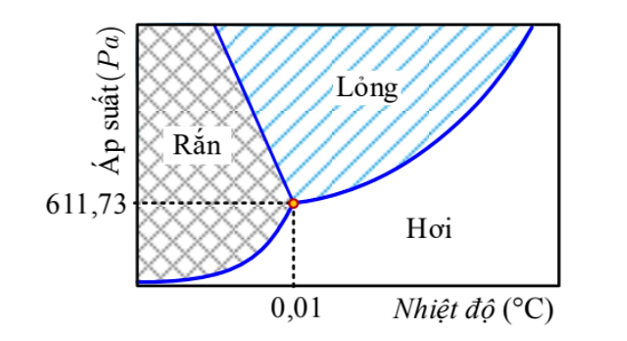
Phân tích đồ thị hình vẽ.
Dựa vào lí thuyết sự chuyển thể của chất.
Lời giải
Dựa vào đồ thị trên ta có:
Giữ nguyên áp suất, nếu tăng nhiệt độ hệ chuyển thành thể hơi.
Giữ nguyên áp suất, nếu giảm nhiệt độ, hệ chuyển thành thể rắn.
Giữ nguyên nhiệt độ, tăng áp suất, hệ chuyển thành thể lỏng.
Giữ nguyên nhiệt độ, giảm áp suất, hệ chuyển thành thể hơi.
Vậy đáp án sai là D.
Đăng nhập để xem lời giải
Lưu tiến độ và luyện tập hiệu quả hơn. Hoàn toàn miễn phí!
Lời giải
Đáp án đúng là "168"
Phương pháp giải
Ứng dụng tích phân
Lời giải
Quãng đường ô tô đi được từ lúc lăn bánh đến khi được phanh:
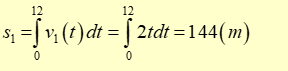
Vận tốc \({v_2}\left( t \right)\left( {m/s} \right)\) của ô tô từ lúc được phanh đến khi dừng hẳn thỏa mãn:
\({v_2}\left( t \right) = \mathop \smallint \nolimits^ - 12dt = - 12t + C\),
\({v_2}\left( {12} \right) = {v_1}\left( {12} \right) = 24 \Rightarrow C = 168 \Rightarrow {v_2}\left( t \right) = - 12t + 168\left( {{\rm{m}}/{\rm{s}}} \right)\)
Thời điểm xe dừng hẳn tương ứng với thỏa mãn \({v_2}\left( t \right) = 0 \Leftrightarrow t = 14\left( s \right)\)
Quãng đường ô tô đi được từ lúc xe được phanh đến khi dừng hẳn là:
\({s_2} = \int\limits_{12}^{14} {{v_2}\left( t \right)dt} = \int\limits_{12}^{14} {\left( { - 12t + 168} \right)dt} = 24m\)
Quãng đường cần tính \(s = {s_1} + {s_2} = 144 + 24 = 168\left( m \right)\)
Câu 3
Đăng nhập để xem lời giải
Lưu tiến độ và luyện tập hiệu quả hơn. Hoàn toàn miễn phí!
Lời giải
Bạn cần đăng ký gói VIP ( giá chỉ từ 250K ) để làm bài, xem đáp án và lời giải chi tiết không giới hạn.

Đăng nhập để xem lời giải
Lưu tiến độ và luyện tập hiệu quả hơn. Hoàn toàn miễn phí!
Lời giải
Bạn cần đăng ký gói VIP ( giá chỉ từ 250K ) để làm bài, xem đáp án và lời giải chi tiết không giới hạn.
Đăng nhập để xem lời giải
Lưu tiến độ và luyện tập hiệu quả hơn. Hoàn toàn miễn phí!
Lời giải
Bạn cần đăng ký gói VIP ( giá chỉ từ 250K ) để làm bài, xem đáp án và lời giải chi tiết không giới hạn.
Đăng nhập để xem lời giải
Lưu tiến độ và luyện tập hiệu quả hơn. Hoàn toàn miễn phí!
Lời giải
Bạn cần đăng ký gói VIP ( giá chỉ từ 250K ) để làm bài, xem đáp án và lời giải chi tiết không giới hạn.
Câu 7
Đăng nhập để xem lời giải
Lưu tiến độ và luyện tập hiệu quả hơn. Hoàn toàn miễn phí!
Lời giải
Bạn cần đăng ký gói VIP ( giá chỉ từ 250K ) để làm bài, xem đáp án và lời giải chi tiết không giới hạn.
Đăng ký để học cùng Vietjack. Hoàn toàn miễn phí!
Bằng việc đăng ký, bạn đồng ý với Điều khoản sử dụng và Chính sách bảo mật của Vietjack.
 Nhắn tin Zalo
 Hỏi bài tập