




















1. Badminton, court or lawn game played with lightweight rackets and a shuttlecock. Historically, the shuttlecock (also known as a “bird” or “birdie”) was a small cork hemisphere with 16 goose feathers attached and weighing about 0.17 ounce (5 grams). These types of shuttles may still be used in modern play, but shuttles made from synthetic materials are also allowed by the Badminton World Federation. The game is named for Badminton, the country estate of the dukes of Beaufort in Gloucestershire, England, where it was first played about 1873. The roots of the sport can be traced to ancient Greece, China, and India, and it is closely related to the old children’s game battledore and shuttlecock. Badminton is derived directly from poona, which was played by British army officers stationed in India in the 1860s. The first unofficial all-England badminton championships for men were held in 1899, and the first badminton tournament for women was arranged the next year.
2. The Badminton World Federation (BWF; originally the International Badminton Federation), the world governing body of the sport, was formed in 1934. Badminton is also popular in Malaysia, Indonesia, Japan, and Denmark. The BWF’s first world championships were held in 1977. A number of regional, national, and zonal badminton tournaments are held in several countries. The best-known of these is the All-England Championships. Other well-known international tournaments include the Thomas Cup (donated 1939) for men’s team competition and the Uber Cup (donated 1956) for women’s team competition.
3. Badminton first appeared in the Olympic Games as a demonstration sport in 1972 and as an exhibition sport in 1988. At the 1992 Games it became a full-medal Olympic sport, with competition for men’s and women’s singles (one against one) and doubles (two against two). Mixed doubles was introduced at the 1996 Games.
4. Competitive badminton is usually played indoors because even light winds affect the course of the shuttlecock. (Recreational badminton, on the other hand, is a popular outdoor summertime activity.) The rectangular court is 44 feet (13.4 metres) long and 17 feet (5.2 metres) wide for singles, 20 feet (6.1 metres) wide for doubles. A net 5 feet (1.5 metres) high stretches across the width of the court at its centre. A clear space of 4 feet (1.3 metres) around the court is needed. Play consists entirely of volleying—hitting the shuttlecock back and forth across the net without letting it touch the floor or ground within the boundaries of the court.
5. In international play, athletes compete in best-of-three-games matches. A game is played to 21 points, provided that the winner has at least a 2-point advantage. If a 2-point advantage is never reached, the first player or team to score 30 points wins. Points were only awarded to the serving side until 2006, when the BWF adopted the “rally scoring” system, under which either side can score at any time.
What does the passage mainly about?
Quảng cáo
Trả lời:
 Giải bởi Vietjack
Đáp án
The history of badminton and how it is played and organized. (1)
Giải thích
Dịch đề: Chủ đề đoạn văn là gì
(1) Lịch sử và cách thức chơi môn cầu lông.
(2) Thế vận hội Olympic cầu lông xuyên suốt năm.
(3) Cách chơi môn cầu lông
(4) Sự phổ biến của môn cầu lông trong cuộc sống hàng ngày và ở các đấu trường quốc tế.
Đoạn văn nói về lịch sử và cách chơi môn cầu lông.
Câu hỏi cùng đoạn
Câu 2:
According to paragraph 1, what is the word “synthetic” closest in meaning to?
Giải bởi Vietjack
Đáp án
man-made.
Giải thích
synthetic (adj): tổng hợp → synthetic material: nguyên liệu tổng hợp
elementary (adj): đơn giản
authentic (adj): xác thực, có thật
man-made (adj): nhân tạo
natural (adj): tự nhiên
→ synthetic = man-made
Câu 3:
In paragraph 5, what does the word “which” refer to?
B. the BWF.
Giải bởi Vietjack
Đáp án
the “rally scoring” system
Giải thích
Trích câu: “Points were only awarded to the serving side until 2006, when the BWF adopted the “rally scoring” system, under which either side can score at any time.”
Tạm dịch: Điểm được tặng cho bên phát cầu cho tới năm 2006, khi BWF áp dụng hệ thống tính điểm cho bên thắng, nghĩa là mỗi bên đều có thể ghi điểm bất cứ khi nào.
Vậy “which” thay thế cho “the rally scoring system.
Câu 4:
According to the passage, what is the most popular badminton tournament?
Giải bởi Vietjack
Đáp án
The All – England.
Giải thích
Trích câu: “The best-known of these is the All-England Championships.”
Tạm dịch: Giải được biết đến nhiều nhất là giải mở rộng Anh.
Câu 5:
“In an international badminton match, player A scores 27 points and player B scores 26 points.” According to the fifth paragraph, what is the fastest way for player B to win the match?
“In an international badminton match, player A scores 27 points and player B scores 26 points.” According to the fifth paragraph, what is the fastest way for player B to win the match?
Giải bởi Vietjack
Đáp án
Wins 3 points in a row.
Giải thích
Trích câu: “In international play, athletes compete in best-of-three-games matches. A game is played to 21 points, provided that the winner has at least a 2-point advantage. If a 2-point advantage is never reached, the first player or team to score 30 points wins.”
Tạm dịch: Trong một trận quốc tế, vận động viên sẽ thi đấu với nhau nhiều nhất 3 trận. Một trận đấu được chơi tới 21 điểm, để chiến thắng thì bên thắng phải vượt ít nhất 2 điểm. Nếu không đạt 2 điểm, người chơi hoặc đội đầu tiên sẽ ghi hưởng 30 điểm dành chiến thắng.
Player A – 27 points, player B – 26 points. Để thắng thì người chơi B phải hơn người A 2 điểm → đạt 29 điểm → thắng 3 điểm liên tiếp.
Đăng nhập để xem lời giải
Lưu tiến độ và luyện tập hiệu quả hơn. Hoàn toàn miễn phí!
Đang tải chế độ Học...
Dành cho bạn Hot
CÂU HỎI HOT CÙNG CHỦ ĐỀ
Câu 1
Đăng nhập để xem lời giải
Lưu tiến độ và luyện tập hiệu quả hơn. Hoàn toàn miễn phí!
Lời giải
Đáp án
1440 số.
Giải thích
Để lập số có số 2 và số 3 đứng cạnh nhau, ta ghép số 2 và 3 với nhau, đặt vào 1 vị trí.
Khi đó ta cần chọn các chữ số sắp xếp vào 5 vị trí để lập được số tự nhiên có 6 chữ số khác nhau.
+ Vị trí đầu tiên có 6 cách chọn: 1; 2 và \(3;4;5;6\).
+ Chọn 4 vị trí còn lại từ tập gồm \(0;1;2\) và \(3;4;5;6\) trừ đi số đã chọn vào vị trí đầu tiên \( \Rightarrow \) có \(A_5^4\) cách.
+ Mặt khác, có \(2! = 2\) cách sắp xếp vị trí cho chữ số 2 và 3.
Vậy có \(6.A_5^4.2 = 1440\) số thỏa mãn.
Đăng nhập để xem lời giải
Lưu tiến độ và luyện tập hiệu quả hơn. Hoàn toàn miễn phí!
Lời giải
Đáp án
31,4mV.
Giải thích
Suất điện động cảm ứng xuất hiện trong khung dây là
\({e_c} = N.\left| {\frac{{\Delta \Phi }}{{\Delta t}}} \right| = \left| {\frac{{\Delta B.S.\cos \alpha }}{{\Delta t}}} \right| = \left| {\frac{{{{10}^{ - 2}}.\pi .0,{1^2}.\cos {0^^\circ }}}{{0,01}}} \right| = \pi {.10^{ - 2}}V \approx 31,4\,\,mV\).
Câu 3
Đăng nhập để xem lời giải
Lưu tiến độ và luyện tập hiệu quả hơn. Hoàn toàn miễn phí!
Lời giải
Bạn cần đăng ký gói VIP ( giá chỉ từ 250K ) để làm bài, xem đáp án và lời giải chi tiết không giới hạn.
Câu 4
Đăng nhập để xem lời giải
Lưu tiến độ và luyện tập hiệu quả hơn. Hoàn toàn miễn phí!
Lời giải
Bạn cần đăng ký gói VIP ( giá chỉ từ 250K ) để làm bài, xem đáp án và lời giải chi tiết không giới hạn.
Câu 5
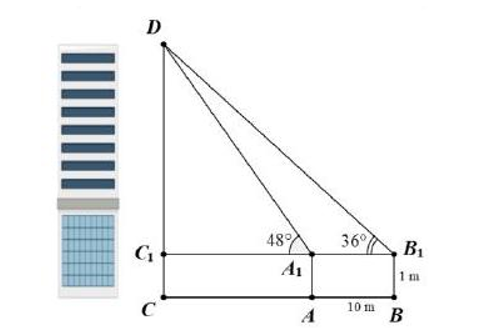
D. \(CD \approx 26,21{\rm{\;m}}\).
Đăng nhập để xem lời giải
Lưu tiến độ và luyện tập hiệu quả hơn. Hoàn toàn miễn phí!
Lời giải
Bạn cần đăng ký gói VIP ( giá chỉ từ 250K ) để làm bài, xem đáp án và lời giải chi tiết không giới hạn.
Câu 6
B. Vua Lê Thái Tổ.
Đăng nhập để xem lời giải
Lưu tiến độ và luyện tập hiệu quả hơn. Hoàn toàn miễn phí!
Lời giải
Bạn cần đăng ký gói VIP ( giá chỉ từ 250K ) để làm bài, xem đáp án và lời giải chi tiết không giới hạn.
Đăng nhập để xem lời giải
Lưu tiến độ và luyện tập hiệu quả hơn. Hoàn toàn miễn phí!
Lời giải
Bạn cần đăng ký gói VIP ( giá chỉ từ 250K ) để làm bài, xem đáp án và lời giải chi tiết không giới hạn.
Đăng ký để học cùng Vietjack. Hoàn toàn miễn phí!
Bằng việc đăng ký, bạn đồng ý với Điều khoản sử dụng và Chính sách bảo mật của Vietjack.
 Nhắn tin Zalo
 Hỏi bài tập