






















Cho tứ diện \[ABCD\]. Gọi \[M\] là trung điểm của đoạn thẳng \[BC\]. Đặt \[\overrightarrow {AB} = \overrightarrow a ,\,\,\overrightarrow {AC} = \overrightarrow b ,\,\,\overrightarrow {AD} = \overrightarrow c \]. Đẳng thức nào sau đây là đúng?
Câu hỏi trong đề: Bộ 20 đề thi Giữa kì 1 Toán 12 có đáp án !!
Quảng cáo
Trả lời:
 Giải bởi Vietjack
Chọn D
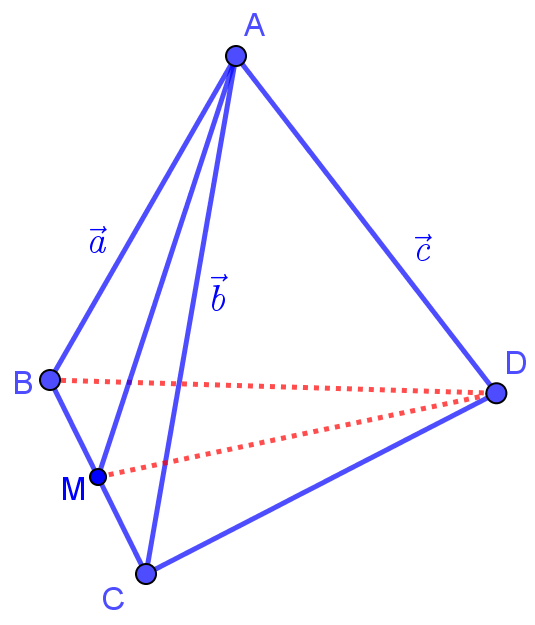
\[\overrightarrow {DM} = \overrightarrow {AM} - \overrightarrow {AD} = \frac{1}{2}\left( {\overrightarrow {AB} + \overrightarrow {AC} } \right) - \overrightarrow {AD} = \frac{1}{2}\left( {\overrightarrow a + \overrightarrow b - 2\overrightarrow c } \right)\].
Hot: 1000+ Đề thi cuối kì 2 file word cấu trúc mới 2026 Toán, Văn, Anh... lớp 1-12 (chỉ từ 60k). Tải ngay
CÂU HỎI HOT CÙNG CHỦ ĐỀ
Lời giải
Doanh thu tối đa mà hộ kinh doanh có thể thu được là \(320x\) (nghìn đồng).
Lợi nhuận hộ kinh doanh thu được là\(L\left( x \right) = 320x - \left( {{x^3} - 3{x^2} + 80x + 500} \right) = - {x^3} + 3{x^2} + 240x - 500\).
Ta có \(L'\left( x \right) = - 3{x^2} + 6x + 240 = 0 \Rightarrow \left[ {\begin{array}{*{20}{c}}{x = 10}\\{x = - 8.}\end{array}} \right.\)
Bảng biến thiên
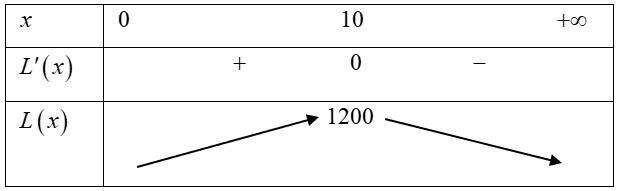
Vậy lợi nhuận lớn nhất mà hộ kinh doanh có được là 1200 nghìn đồng\( = 1,2\) triệu đồng.
Lời giải
a. Sai: Đồ thị của hàm số có tiệm cận đứng là \(x = 1\)
\(y = x - \frac{1}{{x + 1}}\)
Tập xác định \(D = \mathbb{R}\backslash \{ - 1\} \)
\(y' = 1 + \frac{1}{{{{\left( {x + 1} \right)}^2}}} > 0,\forall x \in D\): hàm số luôn luôn đồng biến, không có cực đại, cực tiểu
\(\mathop {\lim }\limits_{x \to - 1 \mp } y = \pm \infty :x = - 1\)là tiệm cận đứng
\(\mathop {\lim }\limits_{x \to \pm \infty } y = x:y = x\)là tiệm cận xiên
b. Đúng: Đồ thị hàm số cắt trục \(Oy\) tại \(M\). Phương trình tiếp tuyến của \(\left( C \right)\) tại \(M\) là \(y = 2x - 1\)
\(M\left( {0; - 1} \right),{y'_0} = 2\)
Phương trình tiếp tuyến \(\left( T \right)\) tại \(M:y = 2(x - 0) - 1 \Leftrightarrow y = 2x - 1\)
c. Sai: Tồn tại hai tiếp tuyến của đồ thị vuông góc với nhau
Tiếp tuyến \(\left( {{T_1}} \right)\) của \(\left( C \right)\) tại \(P\left( {{x_1},{y_1}} \right)\) có hệ số góc
\({k_1} = {y'_{{x_1}}} = 1 + \frac{1}{{{{\left( {{x_1} + 1} \right)}^2}}} > 0\)
Tiếp tuyến \(\left( {{T_2}} \right)\) của \(\left( C \right)\) tại \(Q\left( {{x_2},{y_2}} \right)\) có hệ số góc
\({k_2} = y_{{x_2}}^\prime = 1 + \frac{1}{{{{\left( {{x_2} + 1} \right)}^2}}} > 0\)
Do \({y'_{{x_1}}} > 0,{y'_{{x_2}}} > 0\) nên không thể có 2 tiếp tuyến của \(\left( C \right)\) vuông góc nhau
d. Đúng: Để đường thẳng \(y = k\) cắt \(\left( C \right)\) tại hai điểm phân biệt \(A\) và \(B\) sao cho \(OA \bot OB\) khi đó \(k\) là nghiệm của phương trình \({k^2} - k - 1 = 0\)
\(y = x - \frac{1}{{x + 1}} = \frac{{{x^2} + x - 1}}{{x + 1}}\)
Phương trình hoành độ giao điểm của \(\left( C \right)\) và đường thẳng \(y = k\):
\(\frac{{{x^2} + x - 1}}{{x + 1}} = k \Leftrightarrow \left\{ \begin{array}{l}x \ne - 1\\{x^2} - \left( {k - 1} \right)x - \left( {k + 1} \right) = 0\,\,\,\left( * \right)\end{array} \right.\)
Do vị trí của \(\left( C \right)\) trên hệ tọa độ \(Oxy\), có thể kết luận \(\left( * \right)\) luôn có 2 nghiệm phân biệt \({x_A},{x_B} \ne - 1\) và \(\left\{ {\begin{array}{*{20}{l}}{{x_A} + {x_B} = k - 1}\\{{x_A} \cdot {x_B} = - \left( {k + 1} \right)}\end{array};A\left( {{x_A};k} \right),B\left( {{x_B};k} \right)} \right.\)
\(\overrightarrow {OA} = \left( {{x_A},k} \right),\overrightarrow {OB} = \left( {{x_B},k} \right)\)
\(OA \bot OB \Leftrightarrow \overrightarrow {OA} \cdot \overrightarrow {OB} = 0 \Leftrightarrow {x_A}{x_B} + {k^2} = 0 \Leftrightarrow - k - 1 + {k^2} = 0 \Leftrightarrow \left[ {\begin{array}{*{20}{l}}{k = \frac{{1 - \sqrt 5 }}{2}}\\{k = \frac{{1 + \sqrt 5 }}{2}}\end{array}} \right.\)
Lời giải
Bạn cần đăng ký gói VIP ( giá chỉ từ 250K ) để làm bài, xem đáp án và lời giải chi tiết không giới hạn.
Câu 4
Lời giải
Bạn cần đăng ký gói VIP ( giá chỉ từ 250K ) để làm bài, xem đáp án và lời giải chi tiết không giới hạn.
Lời giải
Bạn cần đăng ký gói VIP ( giá chỉ từ 250K ) để làm bài, xem đáp án và lời giải chi tiết không giới hạn.
Lời giải
Bạn cần đăng ký gói VIP ( giá chỉ từ 250K ) để làm bài, xem đáp án và lời giải chi tiết không giới hạn.
Lời giải
Bạn cần đăng ký gói VIP ( giá chỉ từ 250K ) để làm bài, xem đáp án và lời giải chi tiết không giới hạn.
 Nhắn tin Zalo
 Hỏi bài tập