






















Cho biểu thức:
\[A = \left( {\frac{{\sqrt x - 2}}{{\sqrt x + 3}} + \frac{{\sqrt x - 3}}{{2 - \sqrt x }} - \frac{{9 - x}}{{x + \sqrt x - 6}}} \right):\frac{1}{{x + 2\sqrt x - 3}}\,\,\,\,\,(x \ge 0;x \ne 1;x \ne 4).\]
1. Rút gọn biểu thức A.
2. Tìm tất cả các giá trị của \(x\) để \(A > - 2\) .
Cho biểu thức:
\[A = \left( {\frac{{\sqrt x - 2}}{{\sqrt x + 3}} + \frac{{\sqrt x - 3}}{{2 - \sqrt x }} - \frac{{9 - x}}{{x + \sqrt x - 6}}} \right):\frac{1}{{x + 2\sqrt x - 3}}\,\,\,\,\,(x \ge 0;x \ne 1;x \ne 4).\]
1. Rút gọn biểu thức A.
2. Tìm tất cả các giá trị của \(x\) để \(A > - 2\) .
Quảng cáo
Trả lời:
 Giải bởi Vietjack
1.\[A = \frac{{{{(\sqrt x - 2)}^2} - (\sqrt x - 3)(\sqrt x + 3) - 9 + x}}{{(\sqrt x + 3)(\sqrt x - 2)}}:\frac{1}{{\left( {\sqrt x + 3} \right)\left( {\sqrt x - 1} \right)}}\]
\[ = \frac{{{{(\sqrt x - 2)}^2} - (x - 9) - 9 + x}}{{(\sqrt x + 3)(\sqrt x - 2)}}:\frac{1}{{\left( {\sqrt x + 3} \right)\left( {\sqrt x - 1} \right)}}\]
\[ = \frac{{{{(\sqrt x - 2)}^2}}}{{(\sqrt x + 3)(\sqrt x - 2)}}:\frac{1}{{\left( {\sqrt x + 3} \right)\left( {\sqrt x - 1} \right)}}\]
\[ = \frac{{\sqrt x - 2}}{{\sqrt x + 3}}.\left( {\sqrt x + 3} \right).\left( {\sqrt x - 1} \right)\]
\[ = \left( {\sqrt x - 2} \right)\left( {\sqrt x - 1} \right) = x - 3\sqrt x + 2\]
2.\(A = x - 3\sqrt x + 2 > - 2\) \[(\forall x \ge 0;x \ne 4;x \ne 1).\]
\( \Leftrightarrow x - 3\sqrt x + 4 > 0 \Leftrightarrow {\left( {\sqrt x - \frac{3}{2}} \right)^2} + \frac{7}{4} > 0\,(\forall x \ge 0;x \ne 4;x \ne 1).\)
Vậy \(A > - 2\) với \(\forall x \ge 0;x \ne 4;x \ne 1\)
Đăng nhập để xem lời giải
Lưu tiến độ và luyện tập hiệu quả hơn. Hoàn toàn miễn phí!
Đang tải chế độ Học...
Hot: 1000+ đề thi giữa kì 1 lớp 1-12 đầy đủ các môn (Update 2026) (chỉ từ 60k). Tải ngay
CÂU HỎI HOT CÙNG CHỦ ĐỀ
Đăng nhập để xem lời giải
Lưu tiến độ và luyện tập hiệu quả hơn. Hoàn toàn miễn phí!
Lời giải
\[\frac{{{a^2} + {b^2} + {c^2}}}{{{a^2} + {b^2}}} + \frac{{{c^2}}}{{{{(a + b - c)}^2}}} + \frac{{\sqrt {ab} }}{{a + b}} \ge 3\]\[ \Leftrightarrow \frac{{{c^2}}}{{{a^2} + {b^2}}} + \frac{{{c^2}}}{{{{(a + b - c)}^2}}} + \frac{{\sqrt {ab} }}{{a + b}} \ge 2\]
Đặt \[x = \frac{a}{c}\], \[y = \frac{b}{c}\] (x, y >0)
\[{a^2} + {b^2} + {c^2} + ab - 2bc - 2ca = 0\]
\[ \Leftrightarrow {x^2} + {y^2} + 1 + xy - 2x - 2y = 0 \Leftrightarrow {(x + y - 1)^2} = xy\]
Áp dụng bất đẳng thức Cô-si: \[xy \le \frac{{{{(x + y)}^2}}}{4}\]
Do đó:
\[{\left( {x + y - 1} \right)^2} \le \frac{{{{(x + y)}^2}}}{4} \Rightarrow \left[ {3\left( {x + y} \right) - 2} \right].\left[ {2 - \left( {x + y} \right)} \right] \ge 0 \Leftrightarrow \frac{2}{3} \le x + y \le 2\]
\[P = \frac{{{c^2}}}{{{a^2} + {b^2}}} + \frac{{{c^2}}}{{{{(a + b - c)}^2}}} + \frac{{\sqrt {ab} }}{{a + b}}\]
\[\begin{array}{l} = \frac{1}{{{x^2} + {y^2}}} + \frac{1}{{{{(x + y - 1)}^2}}} + \frac{{\sqrt {xy} }}{{x + y}} = \frac{1}{{{x^2} + {y^2}}} + \frac{1}{{xy}} + \frac{{\sqrt {xy} }}{{x + y}}\\ = \left( {\frac{1}{{{x^2} + {y^2}}} + \frac{1}{{2xy}}} \right) + \left( {\frac{1}{{2xy}} + \frac{{\sqrt {xy} }}{{x + y}}} \right) \ge \frac{4}{{{{(x + y)}^2}}} + 2\sqrt {\frac{1}{{2(x + y)\sqrt {xy} }}} \end{array}\]
\[P \ge \frac{4}{{{2^2}}} + 2\sqrt {\frac{1}{{2.2}}} = 2\]
Dấu bằng xảy ra khi x = y =1\[ \Leftrightarrow \]a = b = c.
Đăng nhập để xem lời giải
Lưu tiến độ và luyện tập hiệu quả hơn. Hoàn toàn miễn phí!
Lời giải
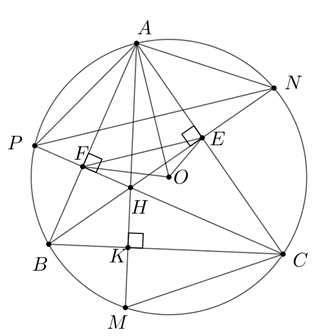
1.\(\widehat {BEC} = \widehat {BFC} = {90^0} \Rightarrow \) tứ giác \(BCEF\) nội tiếp đường tròn đường kính \(BC\)
\( \Rightarrow \widehat {CBE} = \widehat {CFE}\) ( góc nội tiếp cùng chắn cung )
Mà \(\widehat {CBE} = \widehat {CPN}\)( góc nội tiếp cùng chắn cung )
\( \Rightarrow \widehat {CFE} = \widehat {CPN} \Rightarrow EF\,//\,PN\,\)
2.\[\widehat {ABN} = \widehat {ACP}\] (cùng phụ với \(\widehat {BAC}\) )
\( \Rightarrow AN = AP\,\,\)
\(ON = OP = R\)
\( \Rightarrow A,\,O\)nằm trên đường trung trực của \(PN\)
\( \Rightarrow AO \bot PN\)
Mà \(EF\,//\,PN\, \Rightarrow AO \bot EF \Rightarrow {S_{AEOF}} = \frac{{EF.R}}{2}\)
3.\(\widehat {BAM} = \widehat {BCM}\) ( góc nội tiếp cùng chắn cung )
\(\widehat {BAM} = \widehat {BCF}\) (cùng phụ với \(\widehat {ABC}\))
\( \Rightarrow \widehat {BCF} = \widehat {BCM}\)
\(\Delta MCH\) có \(CK\) vừa là đường phân giác vừa là đường cao
\( \Rightarrow \)\(\Delta MCH\)cân tại \(C \Rightarrow K\) là trung điểm của \(MH\)
\[\begin{array}{l}\frac{{AM}}{{AK}} + \frac{{BN}}{{BE}} + \frac{{CP}}{{CF}} = \frac{{AK + KM}}{{AK}} + \frac{{BE + EN}}{{BE}} + \frac{{CF + FP}}{{CF}}\\ = 3 + \frac{{KM}}{{AK}} + \frac{{EN}}{{BE}} + \frac{{FP}}{{CF}}.\end{array}\]
\[\frac{{KM}}{{AK}} = \frac{{KH}}{{AK}} = \frac{{{S_{\Delta BHC}}}}{{{S_{\Delta ABC}}}}\]
Chứng minh tương tự: \[\frac{{EN}}{{BE}} = \frac{{{S_{\Delta AHC}}}}{{{S_{\Delta ABC}}}};\,\frac{{FP}}{{CF}} = \frac{{{S_{\Delta AHB}}}}{{{S_{\Delta ABC}}}}\]
\[\frac{{AM}}{{AK}} + \frac{{BN}}{{BE}} + \frac{{CP}}{{CF}} = 3 + \frac{{{S_{\Delta BHC}} + {S_{\Delta AHC}} + {S_{\Delta AHB}}}}{{{S_{\Delta ABC}}}} = 3 + 1 = 4.\]
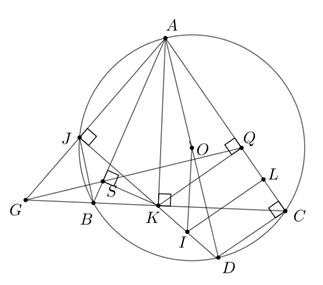
4.\[\widehat {ASK} + \widehat {AQK} = 90^\circ + 90^\circ = 180^\circ \] nên \[{\rm{AS}}KQ\] là tứ giác nội tiếp
\[ \Rightarrow \widehat {ASQ} = \widehat {AKQ}\]
\[\widehat {AKQ} = \widehat {BCQ}\] (cùng phụ với \(\widehat {CKQ}\) )
Do đó \[\widehat {ASQ} = \widehat {BCQ}\]
Suy ra \(BSQC\) là tứ giác nội tiếp.
\( \Rightarrow \widehat {GBS} = \widehat {GQC}\)
Vì \[ASKQ\]là tứ giác nội tiếp nên: \(\widehat {GQK} = \widehat {BAK}\)
Mà \(\widehat {BAK} = \widehat {GKS}\)(cùng phụ với \(\widehat {SBK}\)) nên \(\widehat {GQK} = \widehat {GKS}\)
Từ (1) và (2) \[ \Rightarrow G{K^2} = GB.GC\,\,\]
\[ \Rightarrow G{K^2} = GJ.GA \Rightarrow \frac{{GK}}{{GA}} = \frac{{GJ}}{{GK}}\]
⇒
⇒ AJ ⊥ JK
\(JK\) cắt \(\left( O \right)\) tại \(D\) (\(D\)khác \(K\)) thì \(AD\)là đường kính của \(\left( O \right)\).
Gọi \(I\) là trung điểm \(KD\), \(L\) là trung điểm \(QC\).
Khi đó \(OI\) là đường trung bình của \(\Delta AKD \Rightarrow OI{\rm{//}}AK \Rightarrow OI \bot BC\)
Mà \(OB = OC\) nên \(OI\) là trung trực \(BC\) (3)
Vì \(KQ{\rm{//}}DC\) (cùng vuông góc\(AC\)) nên \(KQCD\) là hình thang.
⇒ \(IL\) là đường trung bình của hình thang \(KQCD\)
⇒ \(IL{\rm{//}}KQ \Rightarrow IL \bot QC\)
⇒ \(IL\) là trung trực của \(QC\) (4)
Từ (3) và (4) ⇒ \(I\) là tâm đường tròn ngoại tiếp tứ giác \(BSQC\)
Vậy \(I,\,K,\,J\) thẳng hàng.
Đăng nhập để xem lời giải
Lưu tiến độ và luyện tập hiệu quả hơn. Hoàn toàn miễn phí!
Lời giải
Bạn cần đăng ký gói VIP ( giá chỉ từ 250K ) để làm bài, xem đáp án và lời giải chi tiết không giới hạn.
Đăng nhập để xem lời giải
Lưu tiến độ và luyện tập hiệu quả hơn. Hoàn toàn miễn phí!
Lời giải
Bạn cần đăng ký gói VIP ( giá chỉ từ 250K ) để làm bài, xem đáp án và lời giải chi tiết không giới hạn.
Đăng ký để học cùng Vietjack. Hoàn toàn miễn phí!
Bằng việc đăng ký, bạn đồng ý với Điều khoản sử dụng và Chính sách bảo mật của Vietjack.
 Nhắn tin Zalo
 Hỏi bài tập