






















The table shows the number of exchange students from universities in Europe to Australia and vice versa.
Summarise the information by selecting and reporting the main features, and make comparisons where relevant. Write at least 150 words.
The table shows the number of exchange students from universities in Europe to Australia and vice versa.
Summarise the information by selecting and reporting the main features, and make comparisons where relevant. Write at least 150 words.
Câu hỏi trong đề: 2000 câu trắc nghiệm tổng hợp Tiếng Anh 2025 có đáp án !!
Quảng cáo
Trả lời:
 Giải bởi Vietjack
|
Exchange students from universities in Europe to Australia |
||
|
Countries |
2007 |
2009 |
|
France |
61 |
60 |
|
Sweden |
32 |
42 |
|
United Kingdom |
31 |
25 |
|
Germany |
27 |
63 |
|
The Netherlands |
36 |
36 |
|
Total |
186 |
226 |
|
Exchange students from universities in Australia to Europe |
||
|
Countries |
2007 |
2009 |
|
France |
37 |
58 |
|
Sweden |
33 |
27 |
|
United Kingdom |
32 |
23 |
|
Germany |
18 |
26 |
|
The Netherlands |
32 |
18 |
|
Total |
152 |
152 |
Sample 1:
The following tables demonstrate the amount of exchange students from European universities to Australian universities and vice versa.
Over the period, the total number of exchange students from universities in Europe to Australia climbed significantly, whereas the total number of exchange students from Australia to Europe remained stable.
Examining the number of exchange students from European colleges to Australia, it is discovered that the number of French students decreased from 61 in 2007 to 60 in 2009. In contrast, Germany saw a substantial growth from 27 students in 2007 to 63 students in 2009. The Netherlands, on the other hand, remained unchanged at 36 exchange students throughout the two years.
Considering the number of Australian university exchange students in Europe, the data indicates that France and Germany both experienced a noticeable increase. The number of students in France went from 37 to 58, and the number of students in Germany increased from 18 to 26 over the period. In contrast, the number of exchange students in the Netherlands decreased significantly from 32 in 2007 to 18 in 2009.
Sample 2:
The provided tables present the figures regarding the exchange of students between European and Australian universities during the given period.
Overall, there was a surge in the total count of exchange students from European to Australian institutions. Conversely, the total number of students going from Australian universities to European counterparts remained relatively constant.
Analyzing the exchange of students from European universities to Australian institutions, the total number increased from 186 to 226 students. France led in the count of exchange students with 61 individuals in 2007, which slightly reduced to 60 by 2009. The Netherlands maintained stability with 36 students across both years. Conversely, the United Kingdom experienced a decline from 31 to 25, while Sweden and Germany displayed an opposing trend, rising from 32 and 27 to 42 and 63, respectively, by 2009.
Shifting focus to Australian university students participating in exchange programs in Europe, the total number sustained at 152 students. France remained the highest contributor of exchange students in both 2007 and 2009, recording 37 and 58 students, respectively. Germany also exhibited a similar upward trend, albeit with lower initial figures (18 to 26). In contrast, Sweden, the United Kingdom, and the Netherlands reported nearly identical numbers (33, 32, and 32, respectively) in 2007, and observed decreases in student numbers by 6, 9, and 14 in 2009.
Sample 3:
The tables provide data on how many students were exchanged between European and Australian universities.
Overall, while the total number of exchange students from Europe to Australia rose, the reverse shows no changes. Additionally, in 2009, Germany had the highest number of exchange students in the first table, whereas France held this position in the second table.
Regarding the first table, although France had the largest number of exchange students (61) in 2007, it marginally declined to 60 in 2009. The Netherlands had a similar trend where it stayed exactly stable at 36 for both years. Finally, while the United Kingdom plummeted from 32 to 23, Sweden and Germany had the opposite trend, reaching 42 and 63, respectively, in 2009.
The second table shows France had the most exchange students in 2007 and 2009, 37 and 58, correspondingly. Germany also had a comparable growing trend, with lower numbers (18 to 26). In comparison, Sweden, the United Kingdom, and the Netherlands almost had identical figures (33, 32, and 32, respectively), and they all witnessed decreases in 2009.
Đăng nhập để xem lời giải
Lưu tiến độ và luyện tập hiệu quả hơn. Hoàn toàn miễn phí!
Đang tải chế độ Học...
Hot: 1000+ đề thi giữa kì 1 lớp 1-12 đầy đủ các môn (Update 2026) (chỉ từ 60k). Tải ngay
Đăng ký VIP để học và luyện thi không giới hạn
Trọn bộ quyền lợi trên Vietjack, trong một tài khoản.
- Phòng luyện thi cấp tốc: ĐGNL - ĐGTD, Tốt nghiệp THPT, Ôn vào 10, Ôn vào 6, Ôn Giữa kì/Cuối kì
- Hơn 200K đề thi thử, đề minh hoạ, chính thức các năm
- Với 3tr+ câu hỏi theo các mức độ Nhận biết, Thông hiểu, Vận dụng
- Tải xuống đề thi [DOCX] với đầy đủ đáp án
- Xem hàng ngàn bài giảng đính kèm củng cố thêm kiến thức
- Bao gồm tất cả các bậc từ Tiểu học đến Đại học
- Chặn hiển thị quảng cáo tăng khả năng tập trung ôn luyện
- Đăng ký ngay
CÂU HỎI HOT CÙNG CHỦ ĐỀ
Đăng nhập để xem lời giải
Lưu tiến độ và luyện tập hiệu quả hơn. Hoàn toàn miễn phí!
Lời giải
Sample 1:
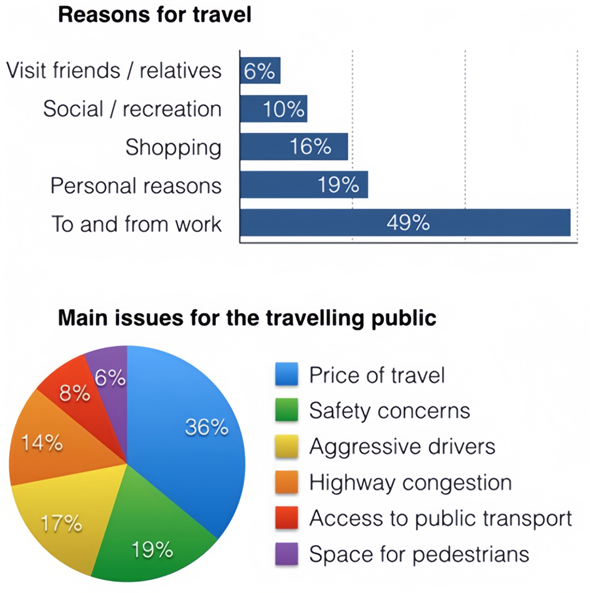
The bar chart and pie chart give information about why US residents travelled and what travel problems they experienced in the year 2009.
It is clear that the principal reason why Americans travelled in 2009 was to commute to and from work. In the same year, the primary concern of Americans, with regard to the trips they made, was the cost of travelling.
Looking more closely at the bar chart, we can see that 49% of the trips made by Americans in 2009 were for the purpose of commuting. By contrast, only 6% of trips were visits to friends or relatives, and one in ten trips were for social or recreation reasons. Shopping was cited as the reason for 16% of all travel, while unspecific ‘personal reasons’ accounted for the remaining 19%.
According to the pie chart, price was the key consideration for 36% of American travellers. Almost one in five people cited safety as their foremost travel concern, while aggressive driving and highway congestion were the main issues for 17% and 14% of the travelling public. Finally, a total of 14% of those surveyed thought that access to public transport or space for pedestrians were the most important travel issues.
Sample 2:
The bar chart compares the figures for Americans going out for five reasons and the pie chart illustrates the percentage of six problems that concerned them when travelling in 2009. Overall, it is clear that the main reason why people in the US went out in 2009 is to commute to work, and the cost of travelling is the problem concerning them the most.
Looking first at the bar graph, the proportion of Americans going out for commuting to work stood at 49%, while the figure for those leaving their house for personal reasons accounted for 19%. In addition, the rate of people in the US going out for shopping and recreation made up 16% and 10%, respectively, while visiting friends or relatives accounted for the lowest percentage, at only 6%.
Turning to the pie chart, the cost of travelling was the most concerning problem of Americans when going out, with the figure making up 36%, while the proportion of safety concerns is half of that, at 19%. In addition, 17% of US citizens were concerned about aggressive drivers, while highway congestion made 14% of them worried when leaving their house. Access to public transportation and places for people to walk accounted for the lowest percentages, at only 8% and 6%, respectively.
Sample 3:
The provided charts offer insights into the reasons for travel and the primary concerns faced by the traveling public in the United States during the year 2009. The data is presented through a bar chart illustrating travel purposes and a pie chart highlighting key issues.
Notably, the primary motivation for travel among Americans in 2009 was commuting to and from work. Simultaneously, the major concern for the traveling public during their trips revolved around the cost associated with travel.
Examining the bar chart in detail reveals that almost half of the trips made by Americans in 2009, precisely 49%, were attributed to commuting. Conversely, visits to friends or relatives accounted for a mere 6%, while social or recreational trips constituted one in ten journeys. Shopping emerged as the purpose for 16% of all travel, leaving the remaining 19% for unspecific ‘personal reasons.’
Turning attention to the pie chart, it becomes evident that cost was the primary consideration for 36% of American travelers. Safety closely followed, with nearly one in five people, or 19%, expressing it as their foremost travel concern. Aggressive driving and highway congestion were significant issues for 17% and 14% of the traveling public, respectively. Additionally, 14% of respondents identified access to public transport or space for pedestrians as the most crucial travel issues.
Sample 4:
The bar chart shows why American people chose to travel, and the pie chart shows the main issues for the travelling public in the USA, both for 2009. The trend suggests that the reason and price were the main issues for travel in the United States. It is clear that commuting from work was reported as the biggest contribution to travel, at 49%. People who went travelling for personal reasons and shopping accounted for 35% when these two groups are combined. However, interaction with friends and relatives only accounted for 25% less than the above categories. And social and recreational activities took up only 6%, which was the lowest figure by more than 43%. The travelling public’s main issues were related to price and safety, with 55% of respondents reporting these two issues. While other issues accounted for a relatively small part. Only 17% of the respondents reported issues with aggressive drivers, while highway congestion accounted for even less at 14% of the issues reported. The percentage of access to public transport and space for pedestrians was much lower than the other categories at less than 10% for both. To conclude, price and commuting time were the dominant factors relating to travel in the US in 2009.
Đăng nhập để xem lời giải
Lưu tiến độ và luyện tập hiệu quả hơn. Hoàn toàn miễn phí!
Lời giải
Sample 1:
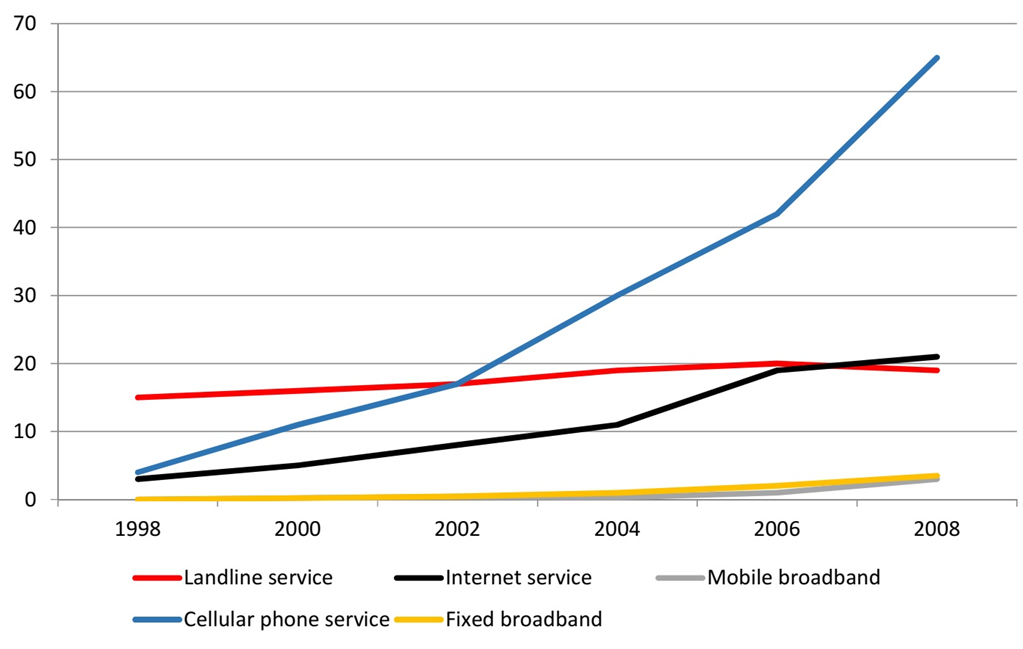
The line graph gives data about the number of users of five different communication services worldwide from 1998 to 2008.
Overall, all services experienced some growth over the 10-year period, with cell phone and Internet services experiencing the most growth and becoming the most popular forms of communication.
In 1998, the figures for cell phone and Internet users started at around 5% of the population. They both increased over the remaining years, with cell phone service gaining the highest position in 2008, with more than 60% percent of the population using this type of service. This number was approximately three times as much as that of Internet service in the same year.
Meanwhile, throughout the 10-year period, little change was seen in the use of landline services, at about 15% of the population. Also, the use of mobile and fixed broadband services was minimal before 2002. The figures for these two services rose slightly to roughly 5% of the population by the last year.
Sample 2:
The line graph gives data about the number of users of 5 different communication services worldwide from 1998 to 2008.
Overall, cell phone and Internet services became more and more popular, and others similarly experienced minimal growth over the years.
In 1998, the figures for cell phone and Internet users started at around 5 per 100 inhabitants. They both increased over the remaining years, with cell phone service gaining the higher position in 2008, at more than 60 users per 100 in habitants. This number was approximately three times as much as that of Internet service in the same year.
Meanwhile, throughout this 10-year period, little change was seen in the use of the landline service, with about 15 users per 100 inhabitants. Also, mobile and fixed broadband had yet to be introduced by 2002. The figures for these two services rose slightly to roughly 5 users per 100 inhabitants in the last year.
Sample 3:
The line graph illustrates the number of people in the world who used five categories of communication services at two-year intervals from 1998 to 2008.
Overall, although all kinds of communication services tended to grow during the entire time period, only the increase in popularity in cellular phone service was significantly higher than the rise in that of other means of communication.
In 1998, the figure for cellular phone service was round about 500 people, as same as Internet service’s. From 1998, the number of individuals using cellular phone services increased dramatically to exactly 6000 people and became the most common means of communication in the year 2008. Additionally, the figure for Internet service was about five times higher than during the period of 10 years.
With 1500 people used, the figure for landline service was the highest number in 1998. However, that figure had a minor increase to 2000 people in 2006 before it dropped slightly to approximately 1800 people in 2008. The figure for mobile broadband and fixed broadband remained nearly 0 throughout the first six-year period. They were also the least popular kinds of communication services despite rising up to 500 people in 2008.
Đăng nhập để xem lời giải
Lưu tiến độ và luyện tập hiệu quả hơn. Hoàn toàn miễn phí!
Lời giải
Bạn cần đăng ký gói VIP ( giá chỉ từ 250K ) để làm bài, xem đáp án và lời giải chi tiết không giới hạn.
Đăng nhập để xem lời giải
Lưu tiến độ và luyện tập hiệu quả hơn. Hoàn toàn miễn phí!
Lời giải
Bạn cần đăng ký gói VIP ( giá chỉ từ 250K ) để làm bài, xem đáp án và lời giải chi tiết không giới hạn.
Đăng nhập để xem lời giải
Lưu tiến độ và luyện tập hiệu quả hơn. Hoàn toàn miễn phí!
Lời giải
Bạn cần đăng ký gói VIP ( giá chỉ từ 250K ) để làm bài, xem đáp án và lời giải chi tiết không giới hạn.
Đăng nhập để xem lời giải
Lưu tiến độ và luyện tập hiệu quả hơn. Hoàn toàn miễn phí!
Lời giải
Bạn cần đăng ký gói VIP ( giá chỉ từ 250K ) để làm bài, xem đáp án và lời giải chi tiết không giới hạn.
Đăng nhập để xem lời giải
Lưu tiến độ và luyện tập hiệu quả hơn. Hoàn toàn miễn phí!
Lời giải
Bạn cần đăng ký gói VIP ( giá chỉ từ 250K ) để làm bài, xem đáp án và lời giải chi tiết không giới hạn.
Đăng ký để học cùng Vietjack. Hoàn toàn miễn phí!
Bằng việc đăng ký, bạn đồng ý với Điều khoản sử dụng và Chính sách bảo mật của Vietjack.
 Nhắn tin Zalo
 Hỏi bài tập