






















The plans below show a student room for two people and a student room for one person at an Australian University. Summarize the information by selecting and reporting the main features and make comparisons where relevant.
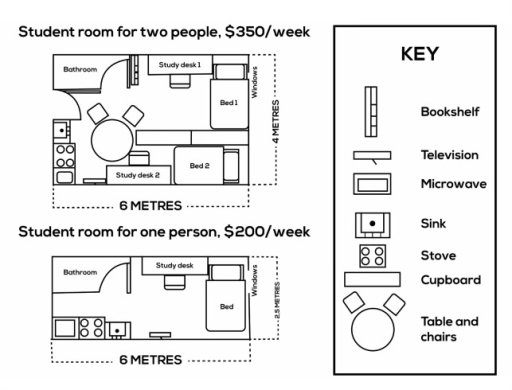
The plans below show a student room for two people and a student room for one person at an Australian University. Summarize the information by selecting and reporting the main features and make comparisons where relevant.
Câu hỏi trong đề: 3000 câu Trắc nghiệm tổng hợp Tiếng Anh 2026 (có đáp án) !!
Quảng cáo
Trả lời:
 Giải bởi Vietjack
Hướng dẫn giải:
Gợi ý 1:
The diagrams compare two types of student accommodation at an Australian university: one for two people and another for a single occupant. Overall, the room for two people is larger, more expensive, and equipped with more furniture and facilities than the single room.
The two-person room, measuring 6 metres by 4 metres, costs $350 per week. It contains two beds and two study desks, each with its own chair and bookshelf. The room also includes a shared bathroom, a kitchen area with a sink, stove, microwave, and cupboard, as well as a small dining area with a table and two chairs. A television is provided for entertainment.
By contrast, the single room is smaller, measuring 6 metres by 3.5 metres, and costs $200 per week. It has one bed, one study desk, and similar kitchen and bathroom facilities. However, it lacks a television and has fewer pieces of furniture, reflecting its simpler design and lower price.
In summary, the two-person room offers more space and amenities suitable for shared living, while the single room provides a more compact and private environment at a lower cost.
(Các sơ đồ so sánh hai loại phòng ký túc xá dành cho sinh viên tại một trường đại học ở Úc: một phòng cho hai người và một phòng cho một người. Nhìn chung, phòng cho hai người rộng hơn, đắt hơn và được trang bị nhiều tiện nghi hơn so với phòng đơn.
Phòng hai người, có kích thước 6 mét x 4 mét, giá 350 đô la mỗi tuần. Phòng có hai giường và hai bàn học, mỗi bàn có ghế và kệ sách riêng. Ngoài ra còn có phòng tắm chung, khu bếp với bồn rửa, bếp, lò vi sóng và tủ đựng đồ, cùng khu ăn uống nhỏ với bàn và hai ghế. Phòng còn được trang bị tivi để giải trí.
Ngược lại, phòng một người nhỏ hơn, kích thước 6 mét x 3,5 mét, giá 200 đô la mỗi tuần. Phòng có một giường, một bàn học và các tiện nghi tương tự ở khu bếp và phòng tắm. Tuy nhiên, phòng không có tivi và ít đồ nội thất hơn, phù hợp với thiết kế đơn giản và giá thấp hơn.
Tóm lại, phòng hai người mang lại không gian rộng rãi và nhiều tiện nghi hơn cho việc sống chung, trong khi phòng một người mang đến môi trường riêng tư và tiết kiệm chi phí hơn.)
Gợi ý 2:
The plans illustrate two types of student rooms at an Australian university: one designed for two students and another for one. It is clear that the shared room is larger and more expensive, while the single room is smaller and more basic.
The shared room measures 6 metres in length and 4 metres in width, costing $350 per week. It includes two beds and two study desks, allowing each student to have a personal workspace. The room also features a shared bathroom and a kitchen equipped with a sink, stove, microwave, and cupboard. A table with two chairs and a television are provided for communal use.
In comparison, the single room is 6 metres long and 3.5 metres wide, with a weekly rent of $200. It contains one bed and one study desk, along with similar kitchen and bathroom facilities. However, it lacks a television and has fewer furnishings, making it more suitable for students who prefer privacy and simplicity.
Overall, the two-person room provides more comfort and shared facilities, while the single room offers a quieter and more affordable option.
(Các sơ đồ minh họa hai loại phòng ký túc xá dành cho sinh viên tại một trường đại học ở Úc: một phòng cho hai sinh viên và một phòng cho một người. Rõ ràng rằng phòng chung lớn hơn và đắt hơn, trong khi phòng đơn nhỏ hơn và đơn giản hơn.
Phòng chung có kích thước 6 mét dài và 4 mét rộng, giá 350 đô la mỗi tuần. Phòng có hai giường và hai bàn học, cho phép mỗi sinh viên có không gian làm việc riêng. Ngoài ra, phòng có phòng tắm chung và khu bếp với bồn rửa, bếp, lò vi sóng và tủ đựng đồ. Một bàn ăn với hai ghế và tivi được bố trí để sử dụng chung.
So với đó, phòng một người có kích thước 6 mét dài và 3,5 mét rộng, giá 200 đô la mỗi tuần. Phòng có một giường và một bàn học, cùng các tiện nghi tương tự ở khu bếp và phòng tắm. Tuy nhiên, phòng không có tivi và ít đồ nội thất hơn, phù hợp với sinh viên thích sự riêng tư và đơn giản.
Nhìn chung, phòng hai người mang lại sự thoải mái và nhiều tiện ích hơn, trong khi phòng một người là lựa chọn yên tĩnh và tiết kiệm hơn.)
Hot: Giáo án năng lực số, PPT AI khởi động lớp 1-12 (Update 2026) (chỉ từ 150k). Tải ngay
CÂU HỎI HOT CÙNG CHỦ ĐỀ
Lời giải
Hướng dẫn giải:
Gợi ý 1:
Nowadays, more and more people prefer to get news online rather than through newspapers or television. This shift is mainly due to convenience and accessibility, and I believe it is largely a positive development.
One reason people turn to the internet is speed. Online platforms provide instant updates, whereas newspapers and TV programs often report events hours later. In addition, the internet offers a wider range of sources, allowing readers to access international news and diverse perspectives. Another factor is flexibility. People can read or watch news on their smartphones anytime and anywhere, unlike traditional media which requires fixed schedules or physical copies.
This trend has several positive effects. It encourages people to stay informed more regularly and promotes global awareness. Furthermore, digital platforms often allow interaction, such as commenting or sharing, which makes news more engaging. However, there are drawbacks, such as the spread of misinformation and reduced trust in online sources.
In conclusion, the growing reliance on the internet for news is driven by convenience and speed. Although it poses challenges, I believe it is a positive development overall, provided that people learn to evaluate sources critically.
(Ngày nay, ngày càng nhiều người thích đọc tin tức trực tuyến hơn là qua báo in hoặc truyền hình. Sự thay đổi này chủ yếu do tính tiện lợi và khả năng tiếp cận, và tôi tin rằng đây phần lớn là một sự phát triển tích cực.
Một lý do khiến mọi người chuyển sang internet là tốc độ. Các nền tảng trực tuyến cung cấp cập nhật tức thì, trong khi báo và chương trình TV thường đưa tin muộn hơn nhiều giờ. Ngoài ra, internet mang lại nhiều nguồn tin hơn, cho phép người đọc tiếp cận tin tức quốc tế và nhiều góc nhìn khác nhau. Một yếu tố khác là sự linh hoạt. Mọi người có thể đọc hoặc xem tin tức trên điện thoại thông minh bất cứ lúc nào, khác với truyền thông truyền thống vốn yêu cầu lịch trình cố định hoặc bản in.
Xu hướng này có nhiều tác động tích cực. Nó khuyến khích mọi người cập nhật thông tin thường xuyên hơn và nâng cao nhận thức toàn cầu. Hơn nữa, các nền tảng kỹ thuật số thường cho phép tương tác, như bình luận hoặc chia sẻ, khiến tin tức hấp dẫn hơn. Tuy nhiên, cũng có hạn chế như sự lan truyền thông tin sai lệch và giảm niềm tin vào nguồn trực tuyến.
Tóm lại, việc ngày càng phụ thuộc vào internet để đọc tin tức xuất phát từ sự tiện lợi và tốc độ. Mặc dù có thách thức, tôi tin rằng đây là một sự phát triển tích cực, miễn là mọi người biết cách đánh giá nguồn tin một cách cẩn trọng.)
Gợi ý 2:
The internet has become the primary source of news for many people, replacing newspapers and television. This change is driven by technological advancement and changing lifestyles, and it has both benefits and drawbacks.
People prefer online news because it is immediate and accessible. Unlike newspapers, which are printed once a day, or TV programs that follow fixed schedules, online platforms update continuously. Moreover, the internet provides multimedia content—videos, images, and live streams—that make news more engaging. Another reason is cost. Most online news is free, whereas newspapers require payment and television often demands subscriptions.
This development is positive in many ways. It democratizes information, giving people access to diverse viewpoints and breaking news at their fingertips. It also reduces paper consumption, which benefits the environment. However, the negative side is the rise of fake news and sensationalism, which can mislead readers. Traditional journalism often has stricter editorial standards, while online platforms sometimes prioritize speed over accuracy.
To sum up, the internet has become the dominant source of news because it is fast, convenient, and cost-effective. While this is mostly positive, society must address the issue of misinformation to maximize its benefits.
(Internet đã trở thành nguồn tin tức chính của nhiều người, thay thế báo in và truyền hình. Sự thay đổi này được thúc đẩy bởi tiến bộ công nghệ và lối sống thay đổi, và nó có cả mặt lợi và hại.
Mọi người thích tin tức trực tuyến vì nó nhanh chóng và dễ tiếp cận. Khác với báo in chỉ phát hành một lần mỗi ngày hoặc chương trình TV theo lịch cố định, các nền tảng trực tuyến cập nhật liên tục. Hơn nữa, internet cung cấp nội dung đa phương tiện—video, hình ảnh và phát trực tiếp—khiến tin tức hấp dẫn hơn. Một lý do khác là chi phí. Hầu hết tin tức trực tuyến miễn phí, trong khi báo in phải trả tiền và truyền hình thường yêu cầu đăng ký.
Sự phát triển này có nhiều mặt tích cực. Nó dân chủ hóa thông tin, giúp mọi người tiếp cận nhiều quan điểm và tin nóng ngay trong tầm tay. Nó cũng giảm tiêu thụ giấy, có lợi cho môi trường. Tuy nhiên, mặt tiêu cực là sự gia tăng tin giả và giật gân, có thể gây hiểu lầm cho người đọc. Báo chí truyền thống thường có tiêu chuẩn biên tập nghiêm ngặt hơn, trong khi nền tảng trực tuyến đôi khi ưu tiên tốc độ hơn độ chính xác.
Tóm lại, internet đã trở thành nguồn tin tức chủ đạo vì nó nhanh, tiện lợi và tiết kiệm chi phí. Mặc dù phần lớn là tích cực, xã hội cần giải quyết vấn đề thông tin sai lệch để tận dụng tối đa lợi ích của nó.)
Lời giải
Hướng dẫn giải:
Gợi ý 1:
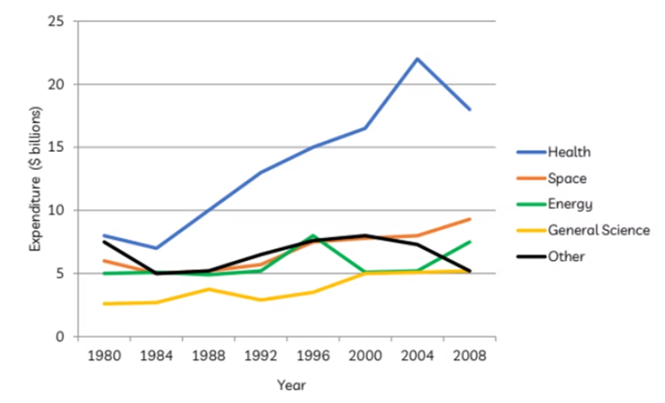
The line graph illustrates how much money the U.S. government spent on research in five different sectors—health, space, energy, general science, and other areas—from 1980 to 2008. Overall, expenditure on health research increased dramatically, while spending on other sectors remained relatively stable or declined slightly.
In 1980, health research received the highest funding at around $8 billion, followed by other areas and space at approximately $7 billion and $6 billion respectively. Energy and general science were the least funded sectors, both below $5 billion. Over the next two decades, spending on health rose steadily, reaching a peak of nearly $20 billion in 2004 before falling slightly by 2008.
By contrast, expenditure on space research grew gradually from $6 billion to about $9 billion by 2008. Energy research fluctuated, peaking at around $9 billion in 1996 before dropping to $6 billion in 2008. General science showed a modest upward trend, increasing from $3 billion to $5 billion. Spending on other areas remained stable until 2000, then declined to $5 billion by the end of the period.
In summary, health research consistently attracted the most funding, while other sectors experienced minor changes or declines over the 28-year period.
(Biểu đồ đường minh họa số tiền mà chính phủ Hoa Kỳ chi cho nghiên cứu trong năm lĩnh vực khác nhau — y tế, không gian, năng lượng, khoa học tổng quát và các lĩnh vực khác — từ năm 1980 đến 2008. Nhìn chung, chi tiêu cho nghiên cứu y tế tăng mạnh, trong khi các lĩnh vực khác tương đối ổn định hoặc giảm nhẹ.
Năm 1980, nghiên cứu y tế nhận được nguồn tài trợ cao nhất, khoảng 8 tỷ USD, tiếp theo là các lĩnh vực khác và không gian với khoảng 7 tỷ và 6 tỷ USD. Năng lượng và khoa học tổng quát là hai lĩnh vực được tài trợ ít nhất, đều dưới 5 tỷ USD. Trong hai thập kỷ tiếp theo, chi tiêu cho y tế tăng đều, đạt đỉnh gần 20 tỷ USD vào năm 2004 trước khi giảm nhẹ vào năm 2008.
Ngược lại, chi tiêu cho nghiên cứu không gian tăng dần từ 6 tỷ lên khoảng 9 tỷ USD vào năm 2008. Nghiên cứu năng lượng biến động, đạt đỉnh khoảng 9 tỷ USD vào năm 1996 rồi giảm xuống 6 tỷ USD vào năm 2008. Khoa học tổng quát tăng nhẹ từ 3 tỷ lên 5 tỷ USD. Chi tiêu cho các lĩnh vực khác ổn định đến năm 2000, sau đó giảm xuống 5 tỷ USD vào cuối giai đoạn.
Tóm lại, nghiên cứu y tế luôn nhận được nguồn tài trợ lớn nhất, trong khi các lĩnh vực khác chỉ có thay đổi nhỏ hoặc giảm nhẹ trong suốt 28 năm.)
Gợi ý 2:
The graph shows U.S. government expenditure on research in five fields—health, space, energy, general science, and other—from 1980 to 2008. It is clear that spending on health rose sharply, whereas other categories saw little growth or even a decline.
In 1980, health was the largest area of investment, at about $8 billion, while space and other sectors followed closely behind. Energy and general science received the least funding, at around $5 billion and $3 billion respectively. Between 1980 and 2004, health spending increased significantly, reaching a peak of $20 billion before falling slightly to $17 billion in 2008.
Space research funding grew steadily throughout the period, rising from $6 billion to $9 billion. Energy spending fluctuated, peaking at $9 billion in the mid-1990s but ending lower at $6 billion. General science showed a slow but consistent increase, while expenditure on other areas remained stable until 2000 and then declined.
Overall, the U.S. government prioritized health research, with its funding far exceeding that of other sectors by the end of the period.
(Biểu đồ cho thấy chi tiêu của chính phủ Hoa Kỳ cho nghiên cứu trong năm lĩnh vực — y tế, không gian, năng lượng, khoa học tổng quát và các lĩnh vực khác — từ năm 1980 đến 2008. Rõ ràng rằng chi tiêu cho y tế tăng mạnh, trong khi các lĩnh vực khác tăng ít hoặc giảm.
Năm 1980, y tế là lĩnh vực được đầu tư nhiều nhất, khoảng 8 tỷ USD, trong khi không gian và các lĩnh vực khác theo sau. Năng lượng và khoa học tổng quát nhận được ít tài trợ nhất, lần lượt khoảng 5 tỷ và 3 tỷ USD. Từ năm 1980 đến 2004, chi tiêu cho y tế tăng đáng kể, đạt đỉnh 20 tỷ USD trước khi giảm nhẹ xuống 17 tỷ USD vào năm 2008.
Chi tiêu cho nghiên cứu không gian tăng đều trong suốt giai đoạn, từ 6 tỷ lên 9 tỷ USD. Năng lượng biến động, đạt đỉnh 9 tỷ USD vào giữa thập niên 1990 nhưng kết thúc thấp hơn ở mức 6 tỷ USD. Khoa học tổng quát tăng chậm nhưng ổn định, trong khi chi tiêu cho các lĩnh vực khác giữ nguyên đến năm 2000 rồi giảm.
Nhìn chung, chính phủ Hoa Kỳ ưu tiên nghiên cứu y tế, với nguồn tài trợ vượt xa các lĩnh vực khác vào cuối giai đoạn.)
Lời giải
Bạn cần đăng ký gói VIP ( giá chỉ từ 250K ) để làm bài, xem đáp án và lời giải chi tiết không giới hạn.
Lời giải
Bạn cần đăng ký gói VIP ( giá chỉ từ 250K ) để làm bài, xem đáp án và lời giải chi tiết không giới hạn.
Lời giải
Bạn cần đăng ký gói VIP ( giá chỉ từ 250K ) để làm bài, xem đáp án và lời giải chi tiết không giới hạn.
Lời giải
Bạn cần đăng ký gói VIP ( giá chỉ từ 250K ) để làm bài, xem đáp án và lời giải chi tiết không giới hạn.
 Nhắn tin Zalo
 Hỏi bài tập